August 27, 2026
WebRTC vs HLS: Which Protocol Should You Actually Build On?
Streaming Tech
Author
•10 min read
Two engineers sit in the same planning meeting and both of them are right. One says the stream has to feel instant, because viewers will be reacting to it in real time. The other says it has to play on every television in the country, or the launch is pointless. Those are both reasonable requirements, and no single protocol satisfies them equally well.
That is the real shape of the WebRTC vs HLS decision. The two were built for different problems - one for conversation, one for broadcast - and most protocol debates go wrong by comparing them on a single axis.
This guide covers how each one moves video, what latency each actually delivers, and the four constraints that decide the answer in practice: device reach, ad monetization, content protection, and what the whole thing costs at scale.
What is the difference between WebRTC and HLS?
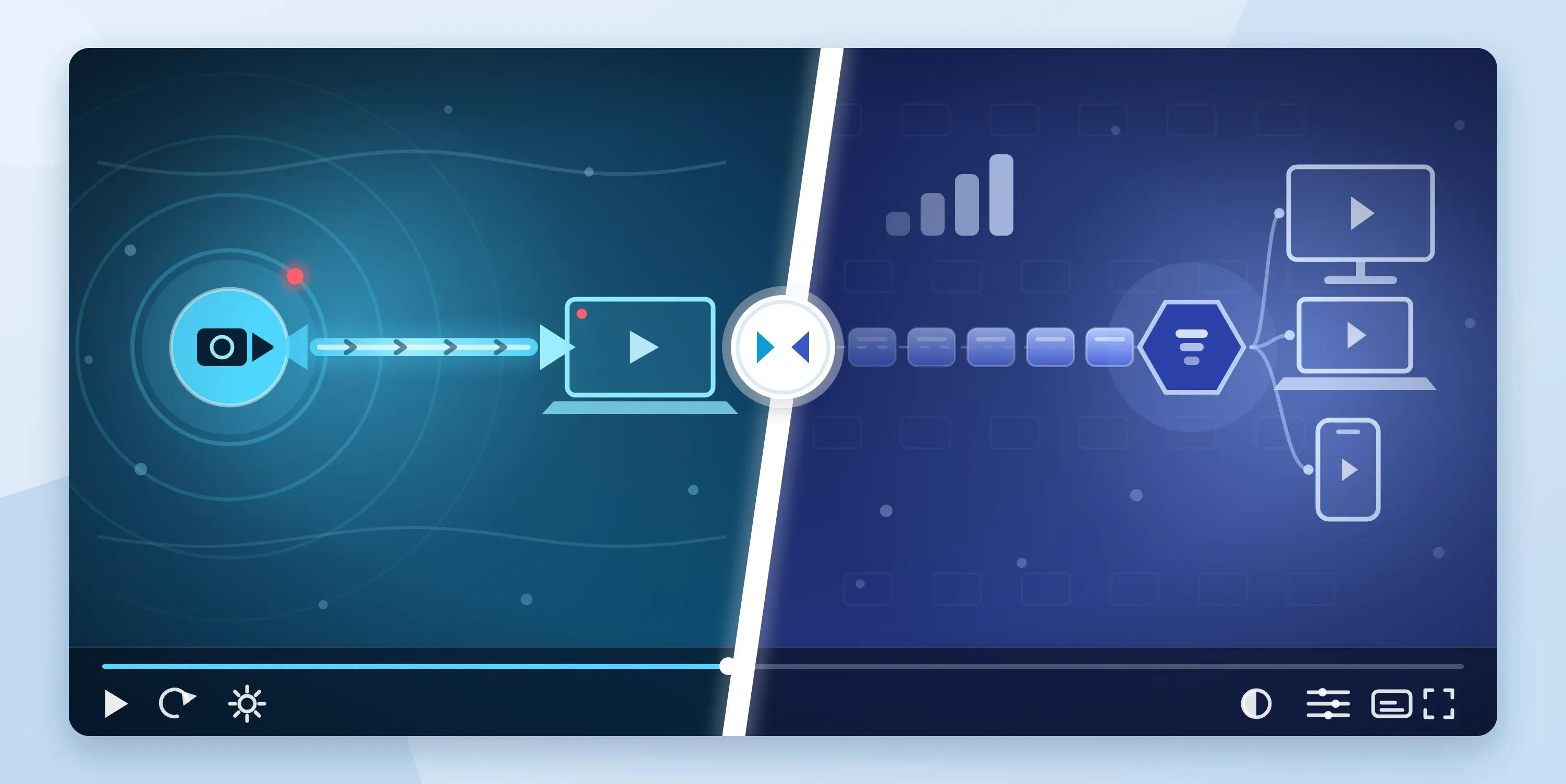
HLS chops video into small files and serves them over ordinary web infrastructure, while WebRTC opens a direct real-time connection and pushes packets straight down it. Everything else follows from that one architectural split.
How HLS delivers video
HLS (HTTP Live Streaming) breaks a stream into short segments - typically two to six seconds each - and publishes a manifest file that tells the player which segment to fetch next. The player pulls those segments over plain HTTP, the same way a browser fetches an image.
Because the segments are ordinary files, any CDN can cache them. The manifest also lists multiple quality renditions, which lets the player climb up and down an adaptive bitrate ladder as network conditions change. That is why HLS behaves well on unreliable connections: it buffers ahead, and it degrades quality instead of stalling.
How WebRTC delivers video
WebRTC (Web Real-Time Communication) skips segments and manifests entirely. It negotiates a peer connection and streams media over UDP, prioritizing speed over completeness - a late packet is simply dropped rather than waited for.
For one-to-many WebRTC live streaming, traffic passes through a selective forwarding unit that receives the publisher's feed and fans it out to each subscriber. There is no file to cache and no manifest to read. Every viewer holds an open, stateful session with your infrastructure.
WebRTC vs HLS at a glance
Across the nine dimensions that decide a real deployment, WebRTC leads on exactly one - latency — and HLS leads on the rest.| | HLS | WebRTC | | ------------------------ | ----------------------------------------- | ----------------------------------------------------- | | Typical latency | 6–30s standard; 2–5s with LL-HLS | Under 500ms, often sub-300ms | | Transport | HTTP over TCP | UDP, with fallback | | Device reach | Effectively universal | Browsers and mobile apps; largely absent on smart TVs | | Adaptive bitrate | Native and mature | Available, less mature | | Server-side ad insertion | Supported | Not supported — no manifest to stitch into | | Content protection | Multi-DRM (FairPlay, Widevine, PlayReady) | Transport encryption only | | Scaling model | Cacheable — one segment serves everyone | Stateful — each viewer is a session | | Cost curve at scale | Flattens | Rises with concurrency | | Best fit | One-to-many broadcast | Interactive, two-way, real time |
One clarification on the protocol that often joins this comparison: in hls vs rtmp or rtmp vs webrtc terms, RTMP now competes for the first mile, not for delivery to viewers. For the delivery-side counterpart to this article, our HLS vs DASH comparison covers the two packaging formats that do compete directly.
How much latency does each protocol actually add?
WebRTC delivers sub-second glass-to-glass latency, while standard HLS runs roughly six to thirty seconds behind live. LL-HLS (Low-Latency HLS) narrows that to about two to five seconds by publishing partial segments before the full segment is ready, and CMAF (Common Media Application Format) chunked delivery lands in a similar range.
So WebRTC wins on latency. That much is settled, and it is the least interesting fact in this comparison.
What is more interesting is how much the gap has closed. At Super Bowl LIX, one streaming service delivered the game to Fire TV viewers 2.6 seconds ahead of the cable feed - the first time at scale that OTT (Over-The-Top) streaming beat traditional broadcast for a live sporting event (TAG Video Systems, 2025). Standard HLS at default settings would never manage that, but a well-tuned low latency HLS pipeline can.
That reframes the question. Do you need fast, or do you need faster than a human reaction? Beating cable, keeping pace with a social feed, avoiding spoilers from a second screen - low latency streaming over HLS handles all of it. Only the second requirement, where a visible delay changes what the viewer does, genuinely forces WebRTC.
Which devices can actually play each protocol?
HLS plays on essentially every screen your subscribers own, while WebRTC playback on connected televisions ranges from limited to unavailable. For an operator, this usually settles the argument before latency is even raised.
Roku OS accounts for 28% of television operating system usage in US broadband households and Samsung's Tizen for another 23% (Parks Associates, 2026). Neither offers a native WebRTC playback path. Add LG webOS and the older Android TV boxes still sitting in living rooms, and a WebRTC-only strategy writes off most of the connected TV (CTV) audience by design.
Where WebRTC is genuinely strong is the second screen: desktop and mobile browsers support it natively, and native iOS and Android apps handle it well. If your product lives in a browser tab, this constraint does not apply to you. If it lives on a television, it is decisive.
What does each protocol do to your ad revenue?
Server-side ad insertion is built on manifest manipulation, and WebRTC has no manifest - so a WebRTC stream cannot carry SSAI. This is the consequence almost nobody raises in protocol comparisons, and for ad-supported platforms it is the whole decision.
Here is the mechanism. SSAI (Server-Side Ad Insertion) works by rewriting the HLS or DASH manifest so that ad segments are stitched into the same stream as the content, arriving at the player as one continuous feed. WebRTC delivers a live packet flow with nothing for an ad server to rewrite. That leaves client-side insertion only, which means exposure to ad blockers, weaker fill rates, and no path to the CTV ad market at all.
That market is not a rounding error. CTV ad spend grew 16% year over year to $23.6 billion in 2024 and was projected to reach $26.6 billion in 2025 (IAB, 2025). If your revenue model is AVOD, FAST, or any hybrid with an ad tier, choosing WebRTC as your delivery layer opts you out of the fastest-growing part of your own business.
Can you protect premium content over WebRTC?
Not to the standard a content licensor will accept. WebRTC encrypts the transport, but transport encryption is not DRM (Digital Rights Management), and rights holders know the difference.
A DRM system involves licence servers, key rotation, playback rules, and output protection that follows the content onto the screen. HLS carries all three major systems — FairPlay, Widevine and PlayReady — which is why studio-grade DRM is available to any HLS-based platform as a configuration choice rather than an engineering project. WebRTC's DTLS-SRTP secures the pipe and stops there.
For user-generated video or a live class, that is fine. For premium sport or a licensed catalogue, it ends the conversation: the licensing agreement will specify DRM, and you will not be able to sign it. The stakes are not theoretical — illegal sports streaming cost the industry roughly $28 billion in lost revenue in 2023 (US Chamber of Commerce, 2026), which is exactly why rights holders write protection requirements into every contract.
What does each protocol cost once you scale?
HLS costs flatten as your audience grows, while WebRTC costs climb with every concurrent viewer. The reason is caching: a single HLS segment sitting at the edge can serve a hundred thousand viewers, so the hundred-thousandth viewer is nearly free.
WebRTC has no equivalent. Each viewer needs media server capacity, fanned out through selective forwarding units in every region you serve. WebRTC scalability is an infrastructure problem you solve by adding servers, and the bill tracks concurrency almost linearly.
This matters most at exactly the wrong moment. Live sports create traffic peaks of three to four times normal network usage (AppLogic Networks, 2025) — and a peak is when a stateful, non-cacheable architecture is both most expensive and most fragile. Getting the CDN layer right for live delivery is what keeps that curve manageable.
Delivery economics are the part operators most often underestimate: an architecture that works beautifully in a pilot behaves very differently at fifty thousand concurrent viewers. If you want to pressure-test the numbers against a realistic audience projection, our team is happy to walk through it with you.
Which protocol should you choose for your use case?
Choose WebRTC only when a delay the viewer can notice would break the product, and choose HLS for everything else. That single test resolves most cases quickly.
| Use case | Protocol | Why |
|---|---|---|
| Live sports and events to TV audiences | HLS (LL-HLS) | Device reach, DRM, ad insertion |
| Linear channels and FAST (free ad-supported streaming TV) | HLS | Manifest-based ad insertion is the business model |
| On-demand (VOD) catalogue | HLS | Latency is irrelevant, caching is everything |
| Live auctions, betting, trading | WebRTC | A visible delay changes the outcome |
| Watch parties and live shopping | WebRTC | Two-way interaction is the product |
| Live classes and telehealth | WebRTC | Conversation, not broadcast |
| Second-screen companion feeds | WebRTC alongside HLS | Sync matters more than picture quality |
Why most platforms end up running both
The production answer is usually not one protocol but a default and an exception. HLS carries the main delivery path to every screen with full DRM and ad insertion, and WebRTC runs on the specific interactive surfaces where real time earns its cost — the bidding overlay, the co-watch room, the studio return feed.
The market context makes this the sensible shape. Global online video subscriptions reached 2.24 billion at the end of 2025, but growth is expected to slow to 5.6% in 2026 (Omdia, 2026). When new subscribers get harder to find, platforms compete on experience and revenue per subscriber instead — and interactive surfaces are one of the few genuinely new things you can offer an existing audience.
That only works if the backbone underneath is not the thing you are worrying about. inoRain's live streaming service delivers over multi-CDN with failover and multi-DRM, with electronic programme guide, timeshift and catch-up built in, and supports more than ten monetization methods including subscription (SVOD), ad-supported (AVOD), transactional (TVOD), FAST channels and pay-per-view. With delivery, protection and monetization already handled, adding a real-time surface becomes a product decision rather than a re-architecture.
The takeaway
WebRTC wins decisively on latency and loses on nearly everything else an operator needs at scale, and HLS is the mirror image. Low-Latency HLS has closed enough of the gap that the choice is no longer urgent for most broadcast use cases, which frees you to decide on the constraints that actually cost money: which devices you must reach, how you monetize, and what your rights agreements demand.
The more useful question over the next few years is not which protocol wins, but which surfaces of your product justify the price of real time. If you are working through that map now, talk to our team - we can help you separate the parts of your platform that need sub-second delivery from the parts that are better served by a cached, protected HLS backbone.
Frequently Asked Questions
Yes, and it remains the default delivery protocol for most of the streaming industry. Its device reach, CDN economics and support for DRM and ad insertion have no real competitor, and Low-Latency HLS has removed the one weakness that used to count against it.
The main one is latency: standard HLS sits six to thirty seconds behind live, which rules it out for genuinely interactive formats. It also adds packaging overhead, and its segment-based design means the player is always working from video that has already happened rather than video arriving right now.
WebRTC encrypts media in transit, which is enough for user-generated or unlicensed content. It does not provide DRM, so if a rights holder requires FairPlay, Widevine or PlayReady, WebRTC alone will not satisfy the agreement.
There is no fixed ceiling, but every viewer consumes media server capacity, so the answer depends on what you are willing to spend on infrastructure. Broadcast-scale WebRTC audiences are routinely built - the cost curve simply rises with concurrency in a way that HLS delivery does not.
SRT is primarily a contribution protocol, designed to move a high-quality feed reliably from a venue or encoder into your platform over an unpredictable network. WebRTC is a delivery protocol for reaching viewers. In a typical live workflow they sit at opposite ends of the chain rather than competing.
Yes, and many platforms do. A media server can take the WebRTC ingest and repackage it into HLS for wide distribution, which restores device reach, DRM and ad insertion = at the cost of the sub-second latency that made WebRTC attractive in the first place.

Digital Marketing Specialist
Creates digital campaigns that drive growth. Handles social media, SEO, and content marketing. and turns data into clear insights and results. Sona also helps create valuable evergreen content to deliver high-quality information to inoRain's audience.
Subscribe to Our OTT Blog
Want to learn more about OTT technology and monetization? Leave your best email here, and we'll keep you updated with our weekly articles.
Loading...