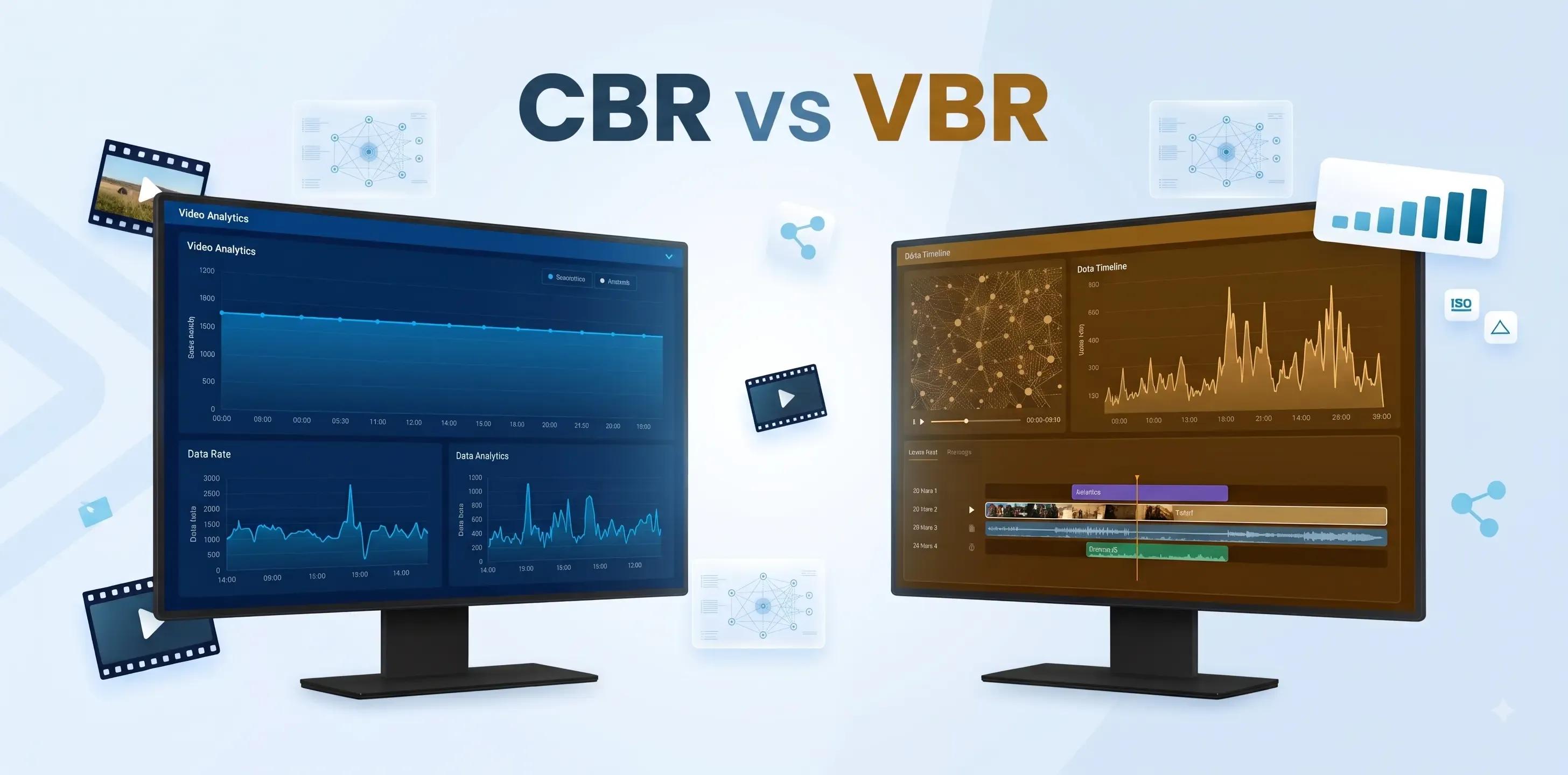
CBR vs VBR: Which Bitrate Mode Is Right for Your Stream?


Every stream you send costs money to deliver, and the bitrate mode you choose decides how predictable that cost is and how steady the picture looks. The CBR vs VBR decision sounds like a setting buried in an export dialog, but for an operator it shapes bandwidth bills, storage footprint, and whether a viewer on a shaky connection keeps watching or drops out.
The stakes scale with your audience. Across a large catalog served to thousands of viewers, small encoding choices compound fast - a few percent shaved off the average stream turns into a materially smaller bandwidth bill and a steadier picture once it plays out across an entire library.
Here is how constant bitrate and variable bitrate actually differ, when each one wins, and why the smartest answer for most OTT (Over-The-Top) services is a third option that sits between them.
What Is CBR (Constant Bitrate)?
CBR (Constant Bitrate) holds the data rate of a video steady for the entire file or stream, no matter how simple or complex each scene is. Bitrate itself is just how much data the encoder spends per second of video, measured in kilobits or megabits per second (kbps/Mbps) - so with CBR, a still title card and a fast action sequence are both allocated exactly the same budget.
That predictability is CBR's real strength. Because the rate never spikes, network capacity is easy to plan and buffering behavior stays stable, which matters when you are pushing a live signal through a fixed transport pipe.
The weakness is efficiency. CBR spends bits it does not need on simple scenes and can starve complex ones of the bits they do need, so quality varies shot to shot even though the number on the encoder stays flat. Getting the most out of a fixed budget comes down to smart encoding, but CBR will always trade some quality-per-bit for that steady rate.
What Is VBR (Variable Bitrate)?
VBR (Variable Bitrate) lets the data rate rise for complex scenes and fall for simple ones, aiming for consistent quality rather than a constant rate. Instead of spending the same budget everywhere, the encoder pours bits into the hard-to-compress moments - motion, grain, fast cuts - and pulls them back when the picture is calm.
This is why VBR is more efficient across a catalog. It delivers better quality for the same average size, or the same quality at a smaller average size, and those savings pile up when you serve a title thousands of times. Two-pass VBR pushes this further by analyzing the whole file first, then allocating bits with full knowledge of where they matter.
The efficiency gap is large enough to have reshaped how catalogs are encoded. Content-adaptive encoding, a VBR-based technique that tailors the bitrate to each individual title, can cut data usage by 20 to 30% at the same perceptual quality (NewscastStudio, 2025) - a direct reduction in CDN (Content Delivery Network) and storage cost. The catch is that VBR's peaks are unpredictable, and an uncapped spike can strain a connection or a live pipeline. Modern transcoding pipelines exist largely to manage that trade-off.
CBR vs VBR: A Side-by-Side Comparison
CBR wins on predictability while VBR wins on efficiency and quality-per-bit, so the right CBR vs VBR choice depends on which of those pressures your service feels most. The table below lines up the differences that actually shape a delivery decision.
| Factor | CBR (Constant Bitrate) | VBR (Variable Bitrate) |
|---|---|---|
| How it allocates bits | Fixed rate, every second | Varies with scene complexity |
| Optimizes for | Predictable bandwidth | Consistent quality per bit |
| File / catalog size | Larger on average | Smaller on average |
| Quality on complex scenes | Can degrade (bit-starved) | Holds up (bits go where needed) |
| Bandwidth predictability | High - easy to plan | Lower - peaks unless capped |
| Encoding speed / cost | Faster, lighter | Heavier, especially two-pass |
| Best fit | Live / linear channels | VOD catalogs |
The headline trade-off is simple. CBR gives you a rate you can plan a network around, while VBR gives you a smaller, better-looking catalog for the bits you spend. Which advantage matters more depends on what you are delivering and how it reaches the viewer.
Which Bitrate Mode Is Better for Streaming?
For OTT delivery, the honest answer is neither pure CBR nor pure VBR - it is constrained VBR, also called capped VBR or VBV (Video Buffering Verifier). Constrained VBR keeps VBR's habit of spending bits where the picture needs them, but adds a hard ceiling so the peaks never climb past what the network and the player can absorb.
That ceiling is what makes VBR safe for adaptive delivery. In adaptive bitrate streaming, your video is encoded into a ladder of renditions and the player switches between them as bandwidth changes, using protocols like HLS (HTTP Live Streaming) and DASH (Dynamic Adaptive Streaming over HTTP). Each rung of that ladder needs a predictable maximum so the player can pick the right one and switch cleanly - and an uncapped VBR spike breaks that assumption, causing the stalls adaptive streaming is meant to prevent.
The scale of streaming is exactly why this efficiency discipline pays off. Video is the largest category of internet traffic by volume, with the average user now downloading around 5.6 GB of data per day (AppLogic Networks, 2025) - so every capped bit is bandwidth you are not paying to move at massive volume.
Building an ABR (Adaptive Bitrate) ladder that stays this efficient without buffering is exactly the work a delivery platform is meant to absorb. inoRain's OTT delivery platform for TV providers produces capped-VBR ladders so operators get variable-bitrate efficiency without the peaks that hurt playback.
CBR vs VBR for Live vs VOD
The cleanest way to decide is by workflow: live and linear channels lean toward CBR or tightly capped VBR, while VOD (Video on Demand) catalogs lean toward VBR. The reason is timing - how much you know about the content before it has to reach a viewer.
Live encoding happens in real time, so there is no second pass and no chance to study the whole file first. Fixed transport bandwidth and the need for predictable delivery make a steady rate the safer choice, which is why linear channels behave much like traditional linear TV even when they run over the internet.
VOD is the opposite. You encode a title once and serve it for the life of the asset, so you can afford heavier two-pass or content-adaptive VBR and collect the bandwidth savings on every future play. That efficiency matters more each year as audiences go mobile: video already makes up around half of all mobile data traffic (Ericsson Mobility Report, 2025). A platform that runs both live linear and VOD lets you apply the right mode to each workflow instead of forcing one setting across everything.
How Bitrate Mode Affects Viewer Experience and Cost
Bitrate mode drives two things an operator cares about directly: what the stream costs to deliver and whether viewers stay. Both come down to how well the mode fits the network the viewer is actually on.
Start with the myth that a higher bitrate always means a better picture. It does not - past a certain point, extra bits add cost without visible improvement, and how those bits are allocated matters more than the raw number. This is why bitrate is not the same as resolution: efficient VBR allocation can look better at a lower average rate than a wasteful CBR stream at a higher one.
Experience is where the wrong mode gets expensive. A stream that overshoots the viewer's connection causes rebuffering, and a mode that starves complex scenes looks blocky - both push people to leave. Buffering is one of the fastest ways to lose a viewer, so a bitrate mode that keeps playback smooth on real-world connections is not a technical footnote; it is a retention decision.
Then there is cost. Average bitrate is what drives CDN egress charges and storage across a full catalog, so VBR's lower average is real money at scale through the CDN. Getting the mode right is one of the quieter ways operators protect both margin and retention at the same time.
Conclusion
CBR buys predictability and VBR buys efficiency, and for an OTT service the modern answer is usually neither in its pure form - it is capped VBR for on-demand catalogs and CBR or a tight cap for live. Match the mode to the workflow and you protect both delivery cost and viewer experience at once.
As audiences keep shifting to mobile and catalogs keep growing, content-adaptive and per-title VBR techniques will widen that efficiency edge further, while live delivery keeps a durable place for constant bitrate. The operators who come out ahead will not be the ones hunting for a single perfect setting; they will be the ones who apply the right bitrate mode to every stream automatically.
If you would rather your platform handle that decision for every live channel and every title in your catalog, inoRain's team can show you how. Talk to inoRain about your OTT delivery
Frequently Asked Questions

Digital Marketing Specialist
Creates digital campaigns that drive growth. Handles social media, SEO, and content marketing. and turns data into clear insights and results. Sona also helps create valuable evergreen content to deliver high-quality information to inoRain's audience.
Subscribe to Our OTT Blog
Want to learn more about OTT technology and monetization? Leave your best email here, and we'll keep you updated with our weekly articles.
Loading...