CTV vs Linear TV: What Actually Changes for the Operator

Ask an advertiser about CTV vs linear TV and you get a budget question: which line gets the money this quarter. That question has been answered a hundred times, and the answers are mostly good.
Ask a broadcaster the same thing and the question falls apart. You already own a channel, it already has a schedule and an audience, and someone has asked how it reaches connected screens without losing the revenue it earns today. That is not a versus. It is a transition you run while both sides are live.
Here is what actually changes underneath: how the channel is played out, how the ad break gets filled, how the audience is counted, and where the revenue comes from.
Linear TV vs connected TV: what does each term actually mean?
Linear TV is a scheduling model and CTV is a delivery endpoint, which is why comparing them as rival channels leads people astray. They describe different things. One is about time, the other is about the screen.
Linear TV is television programmed on a clock. A schedule decides what plays and when, viewers join whatever is already running, and the same stream goes to everyone at once. Cable, satellite and terrestrial broadcast all carry it, but none of them is what makes it linear - the schedule is. Our linear TV glossary entry covers it in more depth.
CTV (Connected TV) is any television set reaching the internet directly, through a smart TV operating system, a streaming stick or a games console. It says nothing about what plays on it - a CTV screen can show on-demand episodes, a live sports feed or a channel running around the clock. The connected TV glossary entry breaks down the device categories.
Put those two definitions together and the payoff is obvious: you can run linear television on connected TV. That is exactly what a FAST (Free Ad-Supported Streaming TV) channel is - a programmed schedule, delivered over the internet, to a television. The schedule survives. The delivery path changes.
CTV vs linear TV: the differences that matter
The differences that matter to an operator are about inventory and ownership, not picture quality. Here is the honest comparison.
| Linear TV | CTV | |
|---|---|---|
| Delivery path | Cable, satellite, terrestrial broadcast | Public internet, over IP |
| Scheduling | Fixed schedule, same feed for everyone | Schedule or on-demand; feed can differ per viewer |
| Inventory unit | A spot in a break, sold by daypart | An impression, sold per viewer |
| Targeting | Geography, daypart, programme | Household, device, behaviour, first-party data |
| Measurement basis | Panel-based ratings and GRPs (Gross Rating Points) | Census-level impression logs |
| Ad load control | Fixed break length, sold in advance | Signalled avail, filled in real time |
| CPM direction | Lower cost per thousand, larger blocks | Higher cost per thousand, smaller addressable slices |
| Reach profile | Broad, declining, still very large | Narrower per placement, growing |
| Viewer relationship | Usually the distributor's | Yours, if you own the app |
Two rows decide most of what follows. The inventory unit changes from a spot to an impression, so your inventory is no longer a fixed quantity you can sell months ahead - it is a variable that depends on how many people actually watched. And on CTV the viewer relationship can be yours rather than a distributor's, which is the biggest structural gain in this transition.
Is linear TV actually dying?
No, and the framing hides what is really happening. Linear viewing is relocating, not disappearing.
Streaming took a 48.2% share of ad-supported TV in the second quarter of 2026, against 26.6% for broadcast and 25.2% for cable (Nielsen, 2026). Streaming leads any single category by a clear margin. But broadcast and cable together still account for more than half of ad-supported viewing, and live sports pulled broadcast up that quarter rather than down.
The useful reading is not "streaming won." It is that scheduled, ad-supported television remains an enormous business whose delivery path is migrating. The audience did not stop wanting a channel that just plays; they started expecting to find it on a connected screen. If linear were dying, the answer would be to replace it. It is not, so the answer is to move it.
What happens to the channel itself when it moves to CTV?
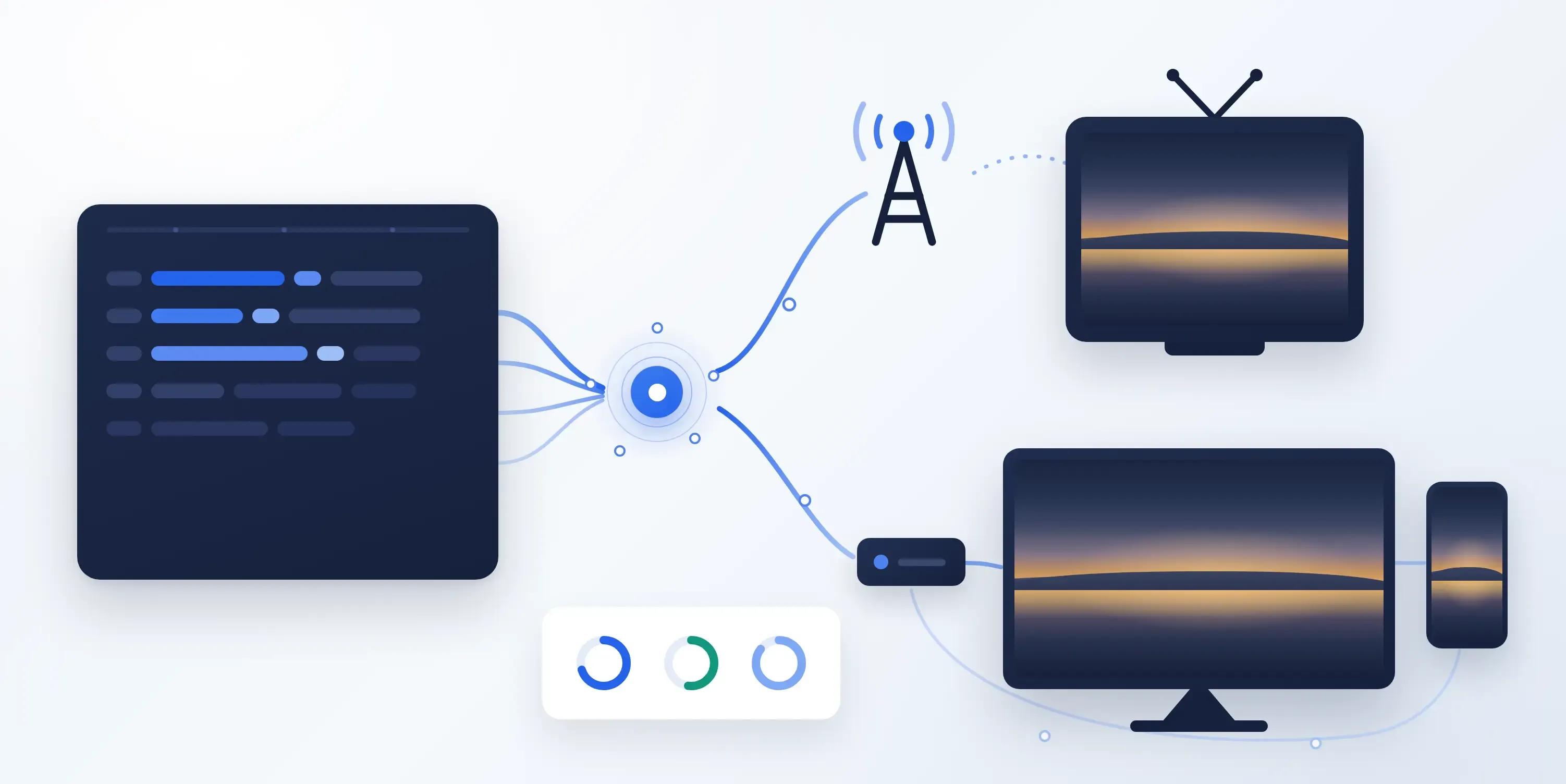
The schedule stops being a broadcast playout chain and becomes a cloud origination job. This is the part of the transition nobody writes about, and it is where most of the work actually sits.
On the broadcast side, playout is a facility: a schedule, a server, graphics inserted downstream, and a signal handed to a distributor. On CTV all of that happens as software, and several things broadcast handled implicitly now have to be explicit.
- Continuous origination. The channel produces an unbroken stream from a playlist, with graphics and branding composited in, and recovers cleanly when an asset is missing.
- Ad avail signalling. Breaks are marked in the stream so an ad system can fill them, rather than being a gap the distributor sells.
- Schedule metadata. Every CTV platform ingests an EPG (Electronic Programme Guide) feed in its own format, and a channel with a broken guide does not exist to viewers browsing for something to watch.
- A catalog behind it. A programmed CTV channel draws from a VOD (Video On Demand) library, because there is no tape room and no satellite feed.
Roughly 1,870 FAST channels now operate globally across 21 countries (eMarketer, 2026). Most are not new networks - they are existing libraries and existing brands, reorganised into a schedule and originated in the cloud.
This is the layer inoRain builds - cloud playout and FAST channel origination with scheduling, graphics, avail signalling and EPG delivery handled as one pipeline rather than four integrations.
How does the ad break change?
A fixed spot load becomes a signalled avail that has to be filled per viewer, in real time, or it becomes slate. That sentence contains the entire commercial risk of the transition.
On broadcast, a two-minute break is two minutes. It was sold in advance, it plays for everyone, and if it did not sell you run a promo. On CTV, the break is a marker in the stream, and when a viewer reaches it the platform asks an ad system what to play for that person. The mechanism that makes this work at scale is SSAI (Server-Side Ad Insertion), which stitches the selected ad into the stream before it reaches the player so it arrives as one continuous video.
Three consequences follow. Fill rate becomes a number you live and die by, because an unfilled avail is lost revenue and a jarring viewer experience at once. Frequency capping becomes your problem, since one household can otherwise see the same advertiser eleven times in an hour. And break length becomes flexible, which is an opportunity rather than a convenience.
The money is moving toward this inventory decisively. US digital video ad spend is set to pass $80 billion in 2026, and digital video will exceed 60% of total TV and video ad spend for the first time (IAB, 2026). The inventory exists. Filling it is an engineering problem before it is a sales problem.
What happens to the money?
Carriage and affiliate fees give way to advertising and subscription revenue, and the two do not arrive on the same schedule. This is the gap that catches operators who plan the technology but not the transition.
Carriage revenue is contractual, predictable and declining. CTV revenue is none of those things at first - it ramps with audience scale and fill rate, and early on it is smaller and noisier than the line it replaces. Planning as though one simply swaps for the other is how a well-executed migration still looks like a failure at year end.
The long-run direction is not in doubt. Traditional linear TV advertising is forecast to fall from $123 billion in 2025 to $113 billion by 2030, while online video advertising rises from $309 billion to $540 billion over the same period (Omdia, 2026). Linear advertising is not collapsing. It is flat-to-declining next to a market growing by more than $200 billion.
There is a second lever broadcast never offered. Because you own the app, you can layer subscription or premium tiers on the same audience and measure ARPU (Average Revenue Per User) directly, instead of inferring your value from a distributor's subscriber count. CTV CPMs also run higher per thousand than linear, but against smaller slices - whether that trade is favourable depends entirely on your fill rate.
Why is measurement the hardest part of the transition?
Because the two sides count different things, and the industry has not finished reconciling them. This is a genuine unsolved problem, not a tooling gap you can buy your way out of.
Linear measurement is panel-based, expressed in ratings and GRPs - a statistical estimate projected to a population. CTV measurement is census-level: the server knows exactly which sessions played which ad. These are not the same measurement at different resolutions. They answer different questions, and advertisers who buy both need one number.
Deduplication is where it bites. A household that watched your channel on cable on Monday and in your app on Tuesday is one household and two reporting systems, and nothing tells you it was the same people. Addressable TV sits in the middle - targeted ads delivered into a linear feed through the set-top box - and inherits difficulties from both sides rather than resolving them.
The practical position is to instrument the CTV side properly from day one and accept that the blended picture stays approximate for a while. Clean census data on the side you control beats a unified number nobody trusts.
Do you actually have to choose between CTV and linear TV?
No, and the demand data argues strongly against it. Viewers are not asking you to pick either.
51% of US internet households say they prefer a package that combines live TV with their favourite streaming services (Parks Associates, 2026). That is a majority asking for exactly the hybrid that the "CTV vs linear TV" framing treats as a transitional compromise.
The practical shape is simulcast: one origination, one schedule, two distribution paths. The channel is built once in the cloud and delivered to the broadcast chain and to CTV apps in parallel, with breaks signalled so each path fills them its own way. You carry duplicate cost during the overlap - two delivery paths, two ad workflows, two sets of reporting - and in exchange you keep carriage revenue while the CTV side builds audience.
Deciding how long that overlap runs is the real planning work. Our OTT migration guide walks through sequencing it without a gap in service.
Where does OTT fit into this?
OTT (Over-The-Top) is the delivery method, CTV is the screen it arrives on, and a CTV ad is a subset of OTT inventory. A stream watched on a phone is OTT but not CTV. If that distinction matters for how you are buying or selling, our OTT vs CTV comparison handles it properly.
How inoRain approaches the linear-to-CTV transition
We build the layer that lets one schedule serve both paths. For broadcasters and TV operators that means cloud playout and channel origination, avail signalling with server-side insertion, EPG and catch-up, and multi-CDN delivery with failover so the feed holds up under a live audience peak.
For ISPs and MSOs adding streaming inventory to an existing line-up, the same stack turns a channel package into apps your subscribers can reach - published across Android TV, Samsung, LG and Roku under your brand, with your billing and subscriber relationship intact. The transition does not have to interrupt what is already earning.
The transition, not the choice
The operators handling this well have stopped treating CTV and linear TV as competing options and started treating them as one schedule with two distribution paths. The schedule is the asset. The delivery path is an implementation detail that happens to be changing.
The timing matters because infrastructure decisions compound. A channel originated properly in the cloud - clean avail signalling, a guide feed every platform accepts, measurement instrumented from day one - can add a distribution path whenever the business case appears. One assembled from workarounds needs rebuilding first.
If you are planning that move, contact us and we will walk you through what it takes for your channel.
Frequently Asked Questions

Digital Marketing Specialist
Creates digital campaigns that drive growth. Handles social media, SEO, and content marketing. and turns data into clear insights and results. Sona also helps create valuable evergreen content to deliver high-quality information to inoRain's audience.
Subscribe to Our OTT Blog
Want to learn more about OTT technology and monetization? Leave your best email here, and we'll keep you updated with our weekly articles.
Loading...