AV1 vs HEVC: Which Codec Should You Stream?

Every stream you send costs money to deliver, and the codec you choose decides how much of it. Compress a video more efficiently and you cut your bandwidth bill, shrink your storage footprint, and hold quality on weak connections - without touching a single frame of content. That is why the AV1 vs HEVC decision matters to operators far more than it first appears: it is a question about delivery economics, not just picture quality.
Here is how HEVC and AV1 actually compare - on efficiency, quality, device reach, licensing, and encoding cost - and how to decide which one your service should ship, including why running both may be the smartest move.
What is HEVC (H.265)?
HEVC (High Efficiency Video Coding), also called H.265, is the codec that made 4K and HDR streaming affordable to deliver, and it remains the workhorse for premium video today. It is the successor to H.264/AVC (Advanced Video Coding), the standard that carried streaming for a decade before it.
HEVC's biggest strength is reach. Almost every current smart TV, set-top box, and smartphone can decode it in hardware, so an operator shipping HEVC can be confident it will play on the screens their audience already owns.
It also set a high bar for efficiency. Even AV1, the newer challenger, improves on HEVC by only about 30% at equal quality (Meta, 2025) - which tells you how strong a baseline HEVC established. It relies on modern video encoding to squeeze high-resolution content into deliverable bitrates.
The catch is what you pay to use it, and that comes down to licensing - a factor we will return to shortly.
What is AV1?
AV1 (AOMedia Video 1) is an open, royalty-free video codec built for internet-scale streaming that compresses video roughly 30% more efficiently than HEVC at the same quality. It was created by the Alliance for Open Media (AOMedia), whose members include Google, Amazon, Meta, Microsoft, and Netflix.
That backing is not theoretical. Over 75% of YouTube's catalog by watch time is already available in AV1, and more than 70% of video watch time across Meta's apps is now served in AV1 (Meta, 2025) - a sign the largest video distributors have already committed to it.
For an operator, AV1's efficiency translates directly into lower delivery costs. Fewer bits per stream means less CDN (Content Delivery Network) egress and smaller storage bills across a large OTT (Over-The-Top) catalog.
AV1 is not a free lunch, though. It is heavier to encode and its hardware decode support is younger than HEVC's - two trade-offs that shape the real decision.
AV1 vs HEVC: A Side-by-Side Comparison
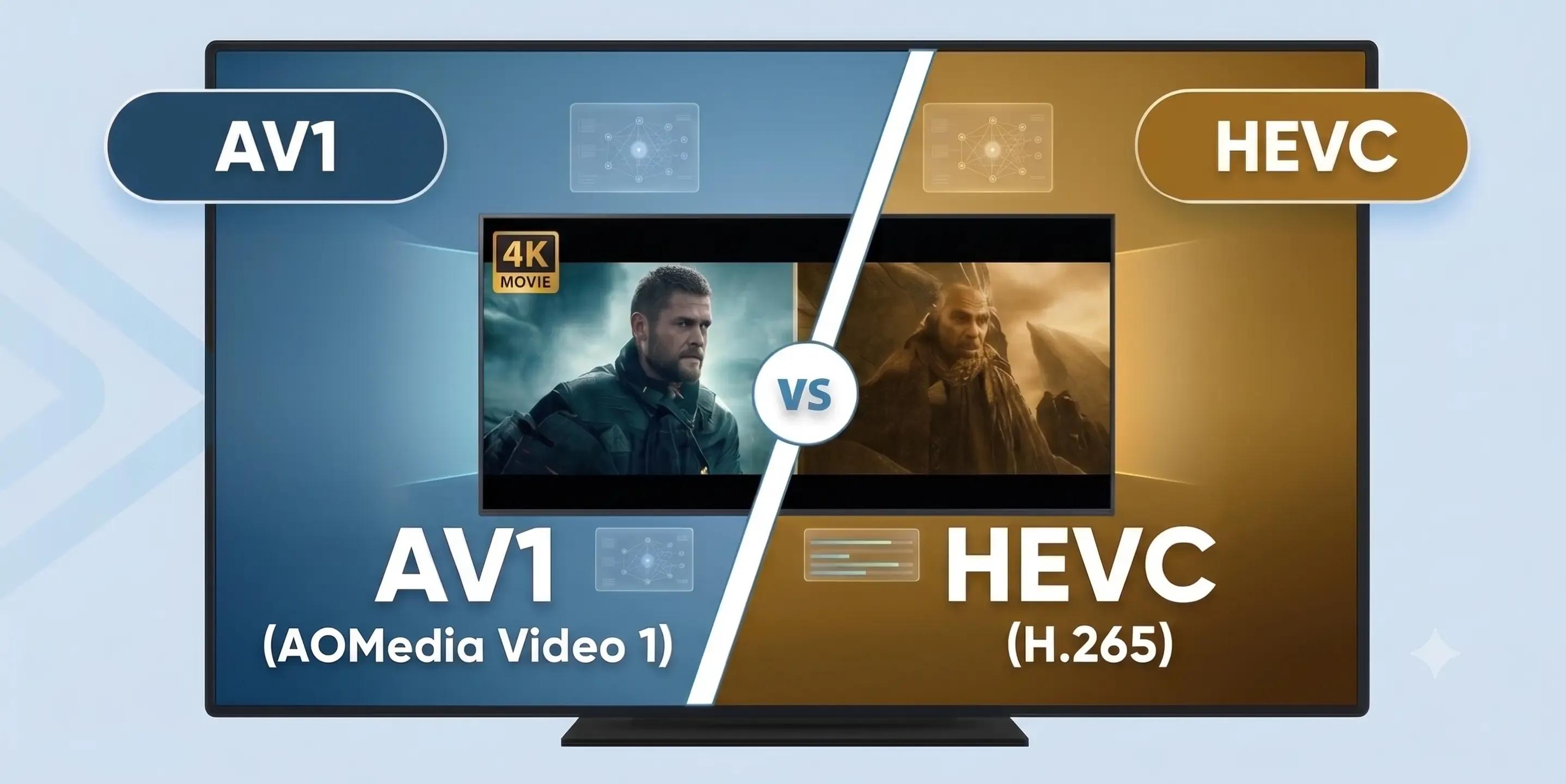
AV1 wins on compression efficiency and licensing, while HEVC wins on universal device support and cheaper encoding today - so the right AV1 vs HEVC choice depends on which of those pressures your service feels most. The table below lines up the differences that actually shape a delivery decision.
| Factor | HEVC (H.265) | AV1 |
|---|---|---|
| Developer / standard | MPEG / ITU standard | Alliance for Open Media (open standard) |
| Licensing | Multiple patent pools; royalty-bearing | Royalty-free |
| Compression vs the other | Baseline | ~30% fewer bits at equal quality |
| Hardware decode support | Near-universal on current devices | Growing; strong on new devices, thin on older ones |
| Encoding cost | Lower; mature, fast encoders | Higher; more compute-intensive |
| Best fit | Maximum device reach today | Bandwidth-heavy catalogs, modern device base |
The headline trade-off is simple. AV1 gives you cheaper delivery and no licensing fees, while HEVC gives you the confidence that your stream will play on virtually any device in the field right now. Which advantage matters more depends on your audience's devices and the size of your bandwidth bill - and you can model that bandwidth impact with a bitrate calculation before committing.
Which Codec Delivers Better Compression and Quality?
AV1 delivers better compression - about 38% smaller files than HEVC and 59% smaller than H.264 at equivalent quality in independent testing (Streaming Media, 2025). In plain terms, AV1 gives you the same picture for fewer bits, or a better picture for the same bits.
For an operator, that efficiency shows up in three places: lower CDN egress charges, a smaller storage footprint for the catalog, and better quality of experience (QoE) for viewers on constrained connections who would otherwise drop to a blurry rendition. Efficient delivery also pairs naturally with adaptive bitrate streaming, where every saved bit widens the room the player has to hold quality when bandwidth dips.
One honest caveat: those savings are ceilings, not guarantees. Real-world gains depend on encoder maturity, the type of content, and how much encoding time you can afford - so the efficiency advantage is real, but it narrows under live conditions and tight compute budgets.
Device Reach: Which Codec Plays on More Screens?
HEVC plays on more screens today - nearly every current TV, set-top box, and smartphone decodes it in hardware, while AV1 support is growing fast but is not yet universal. For an operator, this is often the factor that decides everything, because a codec a viewer's device cannot decode is a codec you cannot ship to them.
The AV1 gap is closing, but unevenly. The smart-TV installed base with AV1 support sits around 50%, while mobile devices with AV1 hardware decode were under 10% in mid-2024 - though nearly all new high-tier phones now include it, and mid-tier chipsets are expected to follow by 2026 (Streaming Media, 2025).
The practical implication is clear: shipping AV1 alone today risks stranding a meaningful slice of your audience on older and mid-tier hardware. This is exactly the kind of device fragmentation a delivery platform is built to absorb - inoRain's multi-codec, multi-device delivery routes the best codec each screen supports, so operators capture AV1's savings without leaving anyone unable to watch.
Licensing and Royalties: The Hidden Cost Difference
AV1 is royalty-free and HEVC is not - the clearest financial difference between the two codecs, and one that reaches beyond the engineering team. AV1 carries no per-device or per-stream licensing fee by design, a direct result of AOMedia building it as an open standard.
HEVC is the opposite. Its royalties are spread across multiple patent pools plus some unpooled patent holders, creating stacked and sometimes uncertain costs that have been a well-documented drag on its adoption (Streaming Media, 2025).
For an operator, that difference is a line item and a legal question, not just a technical one. Choosing AV1 removes a category of licensing exposure that your finance and legal teams would otherwise have to track and budget for over the life of the catalog.
How Much Does AV1 Cost to Encode?
AV1 costs more to encode than HEVC - it is more compute-intensive, especially for live video, which is the main reason it has not replaced HEVC outright despite its better efficiency. Encoding is where AV1 asks you to spend before you save.
That gap is narrowing quickly, though. Modern encoders such as SVT-AV1 now deliver around 30% fewer bits than a comparable HEVC encoder at the same energy cost (Meta, 2025), which means the compute penalty is shrinking even as the bandwidth savings hold.
The operator trade-off comes down to timing. A video-on-demand catalog can absorb heavier encoding once and reap bandwidth savings for the life of the asset, while live channels feel the compute cost in real time. inoRain's transcoding pipeline handles AV1's encoding complexity so operators get the delivery savings without taking on the engineering burden - and if you are weighing where that compute lives, the difference between hardware and software encoding is worth understanding.
AV1 vs HEVC: How to Decide
For most operators, the best AV1 vs HEVC strategy is to run both - serve AV1 to the devices that support it and fall back to HEVC or H.264 everywhere else. That captures AV1's savings on modern hardware without stranding viewers on older screens. Use this quick framework:
- Lean HEVC if maximum device reach today and lower encoding cost matter most, and your audience skews toward existing TVs and set-top boxes.
- Lean AV1 if bandwidth cost and licensing predictability dominate your economics, and your audience skews toward modern devices and browsers.
- Run both (recommended for most) to take AV1's efficiency where it works and keep an HEVC or H.264 fallback for full reach.
The winning strategy is not picking one codec forever. It is delivering the best codec each device supports and letting the platform route it automatically - which is the model inoRain is built around, so your team can focus on content and audience instead of managing parallel encoding stacks.
If you are weighing this decision for your own service, you do not have to solve multi-codec encoding, packaging, and per-device routing by hand. inoRain delivers AV1, HEVC, and H.264 across every screen from a single OTT delivery platform for TV providers.
What About VVC (H.266) and the Next Generation?
VVC (Versatile Video Coding), also called H.266, promises further gains over AV1, but with minimal hardware support and unresolved licensing, it is not a near-term deployment decision. It is a codec to watch, not one to ship.
The timeline underlines the point: meaningful deployment of the next codec generation after it (H.267) is not expected before roughly 2034 to 2036 (Streaming Media, 2025). For the next several years, AV1 versus HEVC is the real choice in front of operators, and a platform-based delivery strategy is what lets you adopt the next codec cleanly whenever it does arrive.
Conclusion
The AV1 vs HEVC question rarely ends in a single winner. AV1 wins on efficiency and licensing, HEVC wins on universal device reach and cheaper encoding today, and for most operators the smartest move is to run both - routing the best codec to each screen.
As AV1 hardware support crosses into the mainstream and encoders keep maturing, the balance will keep tilting toward AV1 - but device reach will keep an HEVC and H.264 fallback relevant for years to come. The operators who win will not be the ones who bet everything on one codec; they will be the ones who deliver the right codec to every viewer without doubling their workload.
If you are ready to capture AV1's savings without leaving any viewer behind, inoRain's team can show you how multi-codec delivery works across every device. Talk to inoRain about your OTT delivery
Frequently Asked Questions

Digital Marketing Specialist
Creates digital campaigns that drive growth. Handles social media, SEO, and content marketing. and turns data into clear insights and results. Sona also helps create valuable evergreen content to deliver high-quality information to inoRain's audience.
Subscribe to Our OTT Blog
Want to learn more about OTT technology and monetization? Leave your best email here, and we'll keep you updated with our weekly articles.
Loading...