How to Create a Micro-Drama App: A 7-Step Guide


Deloitte expects in-app spending on micro-series to more than double this year, to $7.8 billion worldwide. The audience is growing even faster. Short-drama apps passed 850 million downloads in the first quarter of 2026, up 140% year on year.
The format works. The real question is how to create a micro-drama app that earns money, and that comes down to business decisions more than code: which audience to target, what content to launch with, how to charge, and how much to spend on acquiring viewers.
This guide covers those decisions as seven steps, with the features and monetization models behind each one and a real launch from an inoRain client.
What Is a Micro-Drama App?
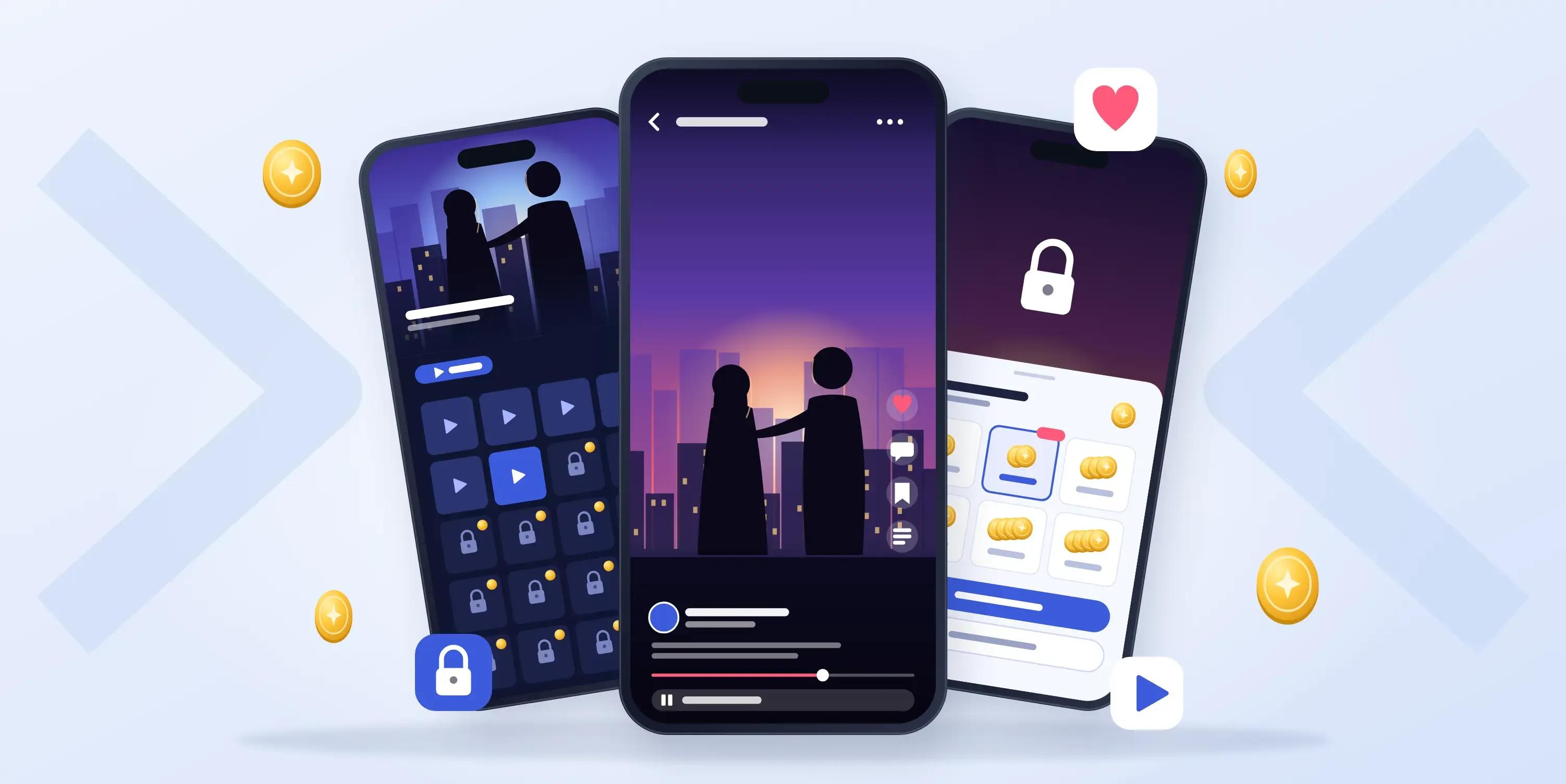
A micro-drama app is a mobile streaming service for scripted series told in vertical episodes of roughly 60 to 90 seconds. A single series can run to hundreds of episodes.
Each episode ends on a cliffhanger. The first few episodes are free, and viewers then unlock the rest with coins or by watching an ad. That is the difference from a generic short-video app: the content is serialized, and the paywall is part of the story.
The format holds attention. By April 2026, viewers spent an average of 25 minutes a day in short-drama apps, up 85% since January 2025, while OTT (Over-The-Top) streaming apps held flat at about 35 minutes (Sensor Tower, 2026). For a closer look at how category leaders earn from that attention, see our breakdown of the ReelShort app business model.
How to Create a Micro-Drama App in 7 Steps
Here is the full sequence, from choosing your audience to deciding which series earns a second season.
Step 1: Pick the Audience You Can Win
Start with a specific audience, not a global one. The global micro-drama apps compete on marketing budgets that few new entrants can match. A language, region or genre they underserve is a market you can lead.
The numbers favour this approach. Southeast Asia, Latin America and India now account for 77% of short-drama downloads (Sensor Tower, 2026). Deloitte also expects the US share of category revenue to fall from half in 2025 to 40% in 2026. Demand is spreading out, and most of it still has no local-language catalog.
Before building, define three things:
- Language and region. Where can you produce or license content that the global apps don't have?
- Genre. Romance, revenge, thriller and fantasy dominate, but a sharper niche is easier to market.
- Viewer profile. Age, device and payment habits all shape your pricing later.
Step 2: Build the Catalog You'll Launch With
Launch with several series, not one. Viewers who finish a story need the next hook ready, or they leave. Most micro-drama catalogs are built from three sources:
- Originals. Series you write and produce for the format. This is your strongest differentiator and the content you fully own.
- Licensed titles. Proven series bought from studios. Licensing fills the library quickly while your originals are in production.
- Localized titles. Licensed series dubbed or subtitled for your market. inoRain's AI subtitles and AI dubbing tools take most of the cost and time out of this.
If you are writing originals, the craft differs from long-form TV. The hook has to land in the first three seconds, every episode ends on a reveal or a question, and the first paywall falls mid-arc. Shoot for the vertical frame from the start rather than cropping widescreen footage. Our guide to vertical filmmaking covers framing and production in detail.
Step 3: Decide How to Build: Custom Development or a White-Label Platform
For most content businesses, a white-label platform is the faster and lower-risk route. Custom micro-drama app development makes sense only when streaming technology is itself your product.
| Custom development | White-label OTT platform | |
|---|---|---|
| Time to launch | Many months of engineering | Weeks of configuration and branding |
| Team needed | Mobile, backend, video and payments engineers | Content, marketing and operations |
| What you maintain | Players, CDN, DRM, app updates, payment flows | Your catalog, pricing and brand |
| Where your budget goes | Infrastructure | Content and user acquisition |
The last row matters most. Every month and every dollar spent rebuilding a video player is money that isn't going into the series that will actually win viewers.
Step 4: Get the Core Features Right
A micro-drama app needs a specific feature set. A standard VOD (Video on Demand) app with a portrait player added on top won't cover it. Check that your platform includes:
- Vertical-first player with swipe-to-next-episode, autoplay and instant start
- Episode-level entitlements, so access is granted per episode rather than per title
- Coin wallet with bundles and configurable episode prices
- Rewarded ad integration tied to the same unlock logic
- CMS (Content Management System) for managing series, episodes, free-episode counts and pricing in one place
- Native iOS and Android apps, plus a web version of your micro-drama service for direct traffic and web checkout
- DRM (Digital Rights Management) to keep paid episodes from being ripped and reposted
- Episode-level analytics showing drop-off points, unlock rates and paywall performance
- Push notifications that bring viewers back when a new episode or series drops
Step 5: Choose Your Monetization Model
The monetization model matters more than anything else you choose. Micro-drama apps earn from many small transactions rather than one monthly fee. Here are the models inoRain supports and how they work together.
Coins and episode unlocks. Viewers buy coin packages and spend them to unlock episodes after the free run. A single unlock typically costs $0.30 to $0.50, and a full series around $10 to $15 (Media Partners Asia via Tech Times, 2026). Paying in coins rather than dollars makes each decision feel small, and that tends to lift total spend.
Rewarded ads. Viewers who won't pay can watch an ad to unlock the next episode instead. They still generate revenue, and some of them become paying viewers later.
AVOD (Advertising-based Video on Demand) ad breaks. Ads placed around free episodes add income from the large share of viewers who never reach the paywall.
Hybrid models. Most successful apps combine these models. In a typical setup, coins are the main revenue line, rewarded ads convert non-payers, and ad breaks cover the free tier. If you're weighing combinations, our guide to hybrid OTT monetization explains how the pieces fit.
Two decisions inside the model have an outsized effect on revenue:
- Paywall placement. Put the first locked episode right after a reveal, not at a natural pause. A viewer in the middle of a twist is deciding whether to continue. A viewer at a chapter break is deciding whether to stop. Our article on the video paywall goes deeper.
- Where checkout happens. App store purchases carry commissions of up to 30%, which is a large share of a 40-cent unlock. The category leader's move into profit coincided with shifting purchases to its own web checkout (Media Partners Asia via Tech Times, 2026). In the US, Apple currently cannot charge a commission on purchases linked out to the web, although it has proposed new fees and the case is still in court (iPhone in Canada, 2026). Rules differ by store and country, so plan your payment flows market by market.
CASE STUDY · SHOVi
A Dutch-language micro-drama app, monetized from the first cliffhanger
CTM Productions saw global vertical-drama apps winning viewers with almost no Dutch content. With inoRain it launched SHOVi on iOS and Android: original and licensed series in one library, coins to unlock episodes, rewarded ads for viewers who'd rather not pay, and a CMS to set coin packages and episode prices. "We wanted our own micro-drama platform without building a streaming stack ourselves." (Peter Van Eyndt, Creative & Project Manager, SHOVi) See how SHOVi launched its micro-drama app
SHOVi also shows Step 1 in practice. It doesn't compete with the global apps across every market. It serves Dutch speakers in the Netherlands and Flanders, an audience those apps had largely ignored.
Step 6: Plan Your Launch and User Acquisition
Budget more for marketing than for anything else. UA (User Acquisition) is the largest cost in this business. The category leader spent an estimated 55% of its 2025 revenue on marketing (Media Partners Asia via Tech Times, 2026).
The upside is that your content doubles as your advertising. The cliffhanger that sells episode nine inside the app also works as a 30-second ad on TikTok, Instagram and YouTube Shorts. A practical launch plan:
- Cut ad creatives from every series before launch, with several hooks per title to test.
- Optimize your app store listings in the local language, with episode stills and genre keywords.
- Start with one or two channels and scale whichever brings paying viewers at the lowest cost.
- Track the right numbers from day one: unlock rate on the first paid episode, the episode where most viewers drop off, 7-day retention, and the cost to acquire a paying viewer against what that viewer spends.
Step 7: Measure, Then Scale the Catalog
Let your data decide which series earn a second season. Episode-level analytics show which hooks convert, which episodes lose viewers, and which genres bring repeat payers. Put your production budget behind those signals.
Once the mobile apps are profitable, expand where it makes sense: new languages through localization, a web app for direct checkout, and smart TV apps for viewers who want to binge on a bigger screen.
How inoRain Helps You Launch a Micro-Drama App
inoRain is an OTT platform provider. You build your micro-drama app on a platform where the hard parts already work together, so your team can focus on stories and audience growth.
That includes:
- a vertical-first player
- episode-level entitlements
- a coin system with flexible pricing controls
- rewarded ads and AVOD ad breaks
- a CMS for series, episodes and pricing
- branded apps published on the App Store and Google Play, with web and smart TV apps when you're ready
- DRM, CDN delivery and episode-level analytics
The AI subtitles and AI dubbing tools then help you take a proven catalog into new languages. It's the same platform SHOVi launched on.
Ready to start? Build your micro-drama app with inoRain.
Conclusion
Creating a micro-drama app is now mostly a content and marketing challenge. The technology is solved, and the format has proven itself. What decides success is picking an audience the global apps underserve, launching with enough series to keep viewers hooked, and pricing every cliffhanger so viewers keep going.
Demand is spreading fast into new languages and regions, so the window for local players is open now. If you're planning your own micro-drama platform, you can launch it on inoRain instead of building it from scratch. Get a free demo.
Frequently Asked Questions

Digital Marketing Specialist
Creates digital campaigns that drive growth. Handles social media, SEO, and content marketing. and turns data into clear insights and results. Sona also helps create valuable evergreen content to deliver high-quality information to inoRain's audience.
Subscribe to Our OTT Blog
Want to learn more about OTT technology and monetization? Leave your best email here, and we'll keep you updated with our weekly articles.
Loading...