How Does Netflix Make Money? The Business Model

Netflix made $45.2 billion in revenue in 2025, up about 16% year over year (Netflix Q4 2025 results). That is a staggering number for a company that started by mailing DVDs. But here is the part that matters for you: the model behind it is simpler than it looks, and most of it is repeatable.
If you own content - a channel, a show library, a creator brand - Netflix is not just a giant to admire. It is a working blueprint. In this article, we break down every way Netflix makes money, explain why each stream works, and show you how to apply the same playbook to your own platform.
How Much Money Does Netflix Make?
Netflix made $45.2 billion in 2025, with $12.05 billion in the fourth quarter alone and 325 million paid memberships worldwide. Q4 also delivered 19 million net new subscribers - the biggest quarter of additions in the company's history.
The scale is huge, but the engine is built from a few repeatable streams. Here is the 2025 snapshot:
| Metric | 2025 Figure |
|---|---|
| Annual revenue | $45.2 billion |
| Q4 revenue | $12.05 billion |
| Paid memberships | 325 million |
| Advertising revenue | $1.5+ billion |
| Free cash flow | $9.5 billion |
On a monthly basis, that annual revenue works out to roughly $3.75 billion per month. The company expects to reach $50.7-51.7 billion in 2026.
What Is Netflix's Business Model?
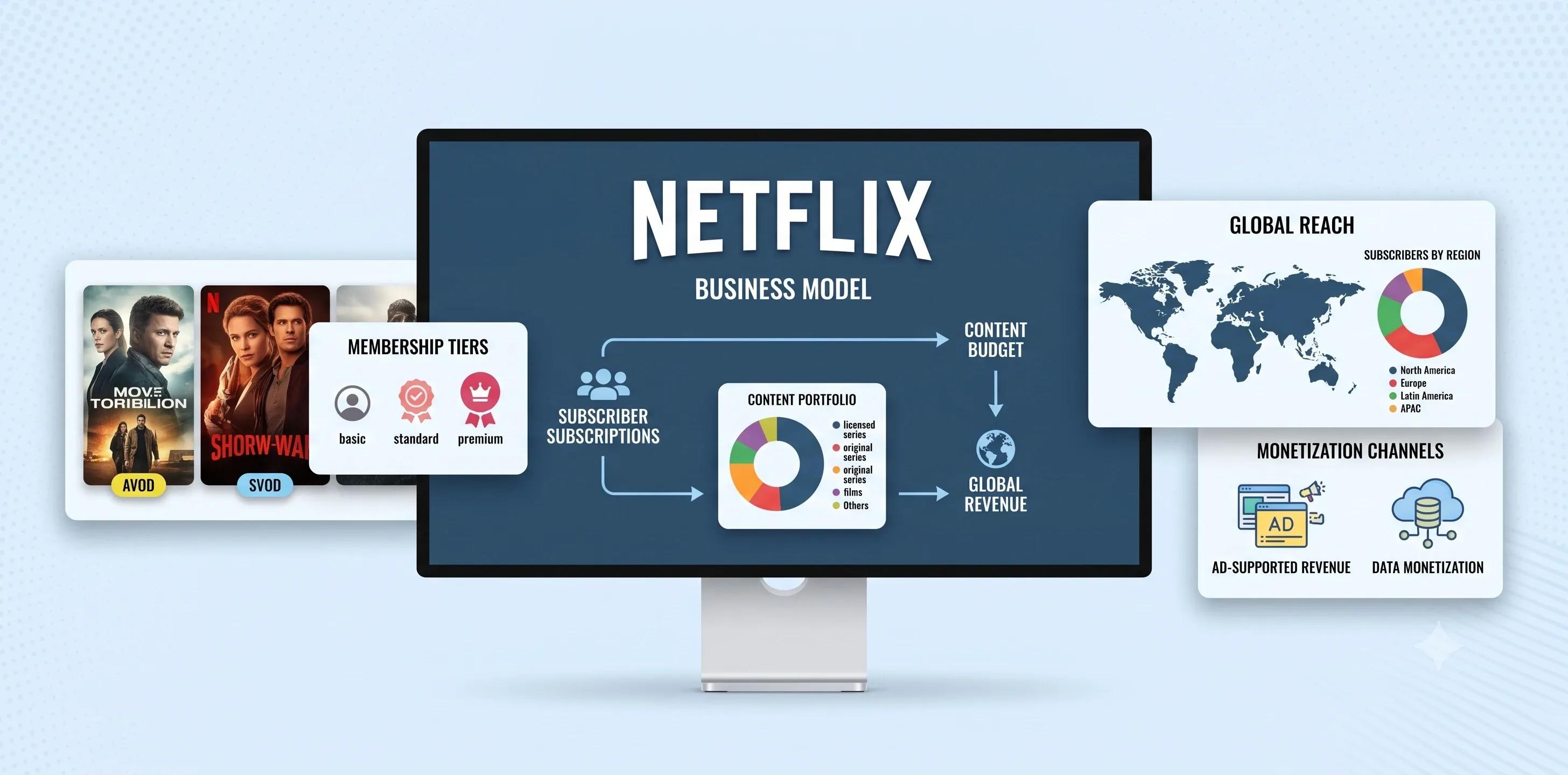
Netflix runs a subscription-first business, now layered with advertising and paid sharing. At its core, it is an SVOD (Subscription Video on Demand) platform: people pay a recurring monthly fee to stream a library of content on any device, with no contract and no per-title charge.
But the model didn't start there, and understanding how it evolved is the key to copying it.
From one revenue stream to a hybrid engine
Netflix's model has moved through three clear phases. It began as a DVD-by-mail service, shifted to pure streaming subscriptions in 2007, then spent fifteen years perfecting that single recurring-revenue engine. The turning point came in November 2022, when Netflix launched an AVOD (Advertising-based Video on Demand) tier — a cheaper plan supported by ads. In May 2023, it added paid sharing to convert shared-password users into paying accounts.
Each move did the same thing: it captured revenue from viewers the previous model was missing. The result is a hybrid business that earns from full-price subscribers, budget viewers on the ad tier, and advertisers — all at once.
How the model keeps growing itself
The engine underneath is a flywheel. Subscription revenue funds new content. Strong content attracts new subscribers and keeps existing ones from canceling. More subscribers mean more revenue to reinvest — and the cycle repeats. Netflix generated $9.5 billion in free cash flow in 2025, and much of it flows straight back into programming that feeds the next turn of the wheel.
This is why the model is so durable. Recurring revenue is predictable, which makes it easy to forecast and reinvest. It also lifts ARPU (Average Revenue Per User) over time as members move to higher tiers or absorb price increases. And because Netflix owns much of its content outright, that library keeps working for years instead of expiring with a licensing deal.
Today the business rests on four pillars — subscriptions, advertising, paid sharing, and content value — and each one is something you can replicate on a platform you own. Here is how each works.
Netflix's Revenue Streams Explained
Netflix makes money from four connected streams: subscriptions, advertising, paid sharing, and the long-term value of its content. Here is how each one works.
1. Subscriptions: The Core Engine
Subscriptions are still where most of Netflix's money comes from. Members pay a recurring monthly fee, and Netflix offers several tiers at different price points to capture different budgets.
The strength here is predictability. Recurring revenue is easier to forecast, easier to grow, and far more stable than one-off sales. It also lifts ARPU (Average Revenue Per User) over time as members move to higher tiers or absorb price increases.
The principle you can copy: recurring subscriptions turn an audience into reliable monthly income.
2. Advertising: The Fastest-Growing Lever
Advertising is Netflix's fastest-growing revenue stream. Ad revenue grew 150% to $625 million in Q4 2025, and topped $1.5 billion for the full year - more than 2.5 times the 2024 figure (Netflix Q4 2025 results).
The reach is just as striking. Netflix's ad-supported tier hit 190 million monthly active viewers by late 2025, and 45% of US households now watch on the ad tier, up from 34% a year earlier. A lower price brings in viewers who would never pay full price, and advertisers pay to reach them.
The principle you can copy: a hybrid model lets you serve budget-conscious viewers and earn from ads at the same time.
3. Paid Sharing: Closing the Leak
Paid sharing is how Netflix turned password freeloaders into paying customers. When the company began cracking down on shared accounts in May 2023, many expected backlash. Instead, Netflix added roughly 50 million new subscribers by early 2024 (Marketing Week).
Some of those users took the cheaper ad tier rather than pay full price. Either way, revenue that was leaking away got recovered.
The principle you can copy: controlling who can access your content protects the revenue you have already earned.
4. Content Value: Why Originals Pay Off
Netflix's movies and shows do not earn money per view. Instead, they attract new subscribers and keep existing ones from canceling. A hit original gives people a reason to sign up and a reason to stay.
Owning original content also reduces Netflix's dependence on licensing deals and builds intellectual property the company controls outright. That owned library becomes an asset that pays off for years.
How Do Netflix Movies and Shows Actually Make Money?
Netflix movies and shows make money by driving subscriptions, not by collecting payment per view. This is the biggest misconception about the business - people assume each stream triggers a payout, like a YouTube video earning ad cents.
It does not work that way. A show's job is to acquire and retain subscribers. When a new season pulls millions of viewers back to the platform, the payoff shows up as fewer cancellations and more sign-ups - not a per-view fee.
That distinction matters for you, too. The value of your content is not just what a single view earns; it is the audience relationship it builds and keeps.
What the Netflix Model Teaches Content Owners
The Netflix model teaches one core lesson: own your audience relationship and monetize it in more than one way. Strip away the scale, and the playbook comes down to four moves you can make on your own platform.
- Own the relationship. Don't rent your audience from a social platform that controls your reach and your payouts. Build a direct connection.
- Charge recurring subscriptions. Predictable monthly revenue beats chasing one-off views.
- Add an ad tier. Reach viewers who won't pay full price, and earn from advertisers.
- Protect your content. Reduce leakage so the revenue you earn stays yours.
The timing has never been better. The global SVOD market reached about $104.66 billion in 2025 and is growing near 9.6% a year through 2030 (Grand View Research). Ad-supported streaming is climbing even faster, with the global AVOD market expanding at more than 19% annually. Hybrid subscription-plus-ads models are becoming the default across the industry - not the exception.
You don't need Netflix's catalog to use Netflix's model. You need a platform that lets you run these revenue streams on your own terms. That's exactly what inoRain is built for - see how it works for content creators.
How to Build Your Own Netflix-Style Platform With inoRain
You can build a Netflix-style revenue engine without a Netflix-sized budget - you need a branded OTT (Over-The-Top) platform with monetization built in. inoRain gives content owners exactly that: a branded streaming app, a centralized CMS (Content Management System), and a dedicated web player that reaches viewers on every device.
The key is that inoRain supports every revenue stream Netflix uses, on content you own - including TVOD (Transactional Video on Demand), or pay-per-view, alongside subscriptions and ads. Here is how the Netflix playbook maps to inoRain:
| Netflix revenue stream | How you run it on inoRain |
|---|---|
| Subscriptions (SVOD) | Launch recurring monthly plans with multiple tiers |
| Advertising (AVOD) | Add an ad-supported tier to reach budget viewers |
| Pay-per-view (TVOD) | Sell one-off access to premium titles or events |
| Hybrid | Combine all three models to maximize revenue per viewer |
A simple way to decide where to start:
- If you want predictable income → lead with subscriptions (SVOD).
- If you want reach and ad revenue → add an ad tier (AVOD).
- If you have premium one-off content → sell it with pay-per-view (TVOD).
On top of monetization, you get user analytics to understand your audience, content localization to grow internationally, and OTT security to protect your library from piracy and unauthorized sharing - the same leak Netflix closed with paid sharing. If you are coming from social platforms, inoRain also has a path built for TikTokers and YouTubers who want to own their audience.
Ready to Build Your Own Netflix-Style Revenue Engine?
Netflix proved that the future of content is owned audiences and layered monetization - subscriptions, ads, and pay-per-view working together. With hybrid models now the industry default, the question is no longer whether to build your own platform, but how fast you can launch one.
inoRain lets you launch a fully branded OTT platform in weeks, not years, with every revenue stream Netflix uses ready to switch on. Stop renting your audience and start owning it. Get a free demo and see how your content can earn like Netflix's.
Frequently Asked Questions

Product Owner
Andranik is a Product Owner specializing in OTT, IPTV, and FAST technologies at inoRain. He leads the development of scalable, end-to-end streaming solutions that enhance video delivery and monetization. His work bridges technical innovation with real business impact, helping platforms and the hospitality sector optimize performance, user experience, and operational efficiency.
Subscribe to Our OTT Blog
Want to learn more about OTT technology and monetization? Leave your best email here, and we'll keep you updated with our weekly articles.
Loading...