What Is OTT Advertising? How Streaming Inventory Gets Sold

Every operator running a streaming service already owns something advertisers want: a signed-in audience watching full-screen video on a television. The useful question is not whether that attention has value. It is how much of it is actually for sale, and how much of it runs past every night unsold.
OTT (Over-The-Top) advertising has two sides. On one, an advertiser decides where to place a budget. On the other, a platform decides what to build so that budget can reach it. Almost everything published on this subject speaks to the first side.
This guide takes the second. If you run an OTT service as an ISP, a TV operator, a broadcaster or a creator with your own app, the ad break in your stream is a revenue line you control directly, and most of the decisions that determine what it earns are technical ones made long before a salesperson gets involved.
Here is what an OTT ad break is worth, how advertising demand reaches it, what you have to build to accept that demand, and the handful of numbers that decide whether any of it works.
What is OTT advertising?
OTT advertising is video advertising delivered inside streaming content over the open internet, sold against a platform's own audience rather than bought as broadcast airtime or cable spot inventory.
The ads are targeted using signals the platform holds itself, and they are measured impression by impression rather than by panel estimate.
Two parties meet in every OTT ad break. The buyer is an advertiser or agency trying to reach a defined audience. The seller, also called the publisher or the supply side, is whoever owns the content and the viewer relationship. If you operate the platform, you are the seller, and your interest is in what the break earns rather than what it costs.
The audience question is settled. Ad-supported television accounted for nearly 73% of all US TV viewing in the first quarter of 2026, and streaming made up 46.6% of that ad-supported total, ahead of broadcast at 28.2% and cable at 25.2% (Nielsen, 2026). Advertising is not a fallback tier bolted onto streaming. It is now the majority of how streaming is watched.
For the plain-language definition of the delivery model itself, see our OTT glossary entry, and for the broader category this sits inside, streaming TV advertising.
How does OTT advertising work?
OTT advertising works by turning a marked break in your content into a real-time decision, made in the few hundred milliseconds before the viewer reaches it. Nothing about the process resembles selling a 30-second spot in a schedule.
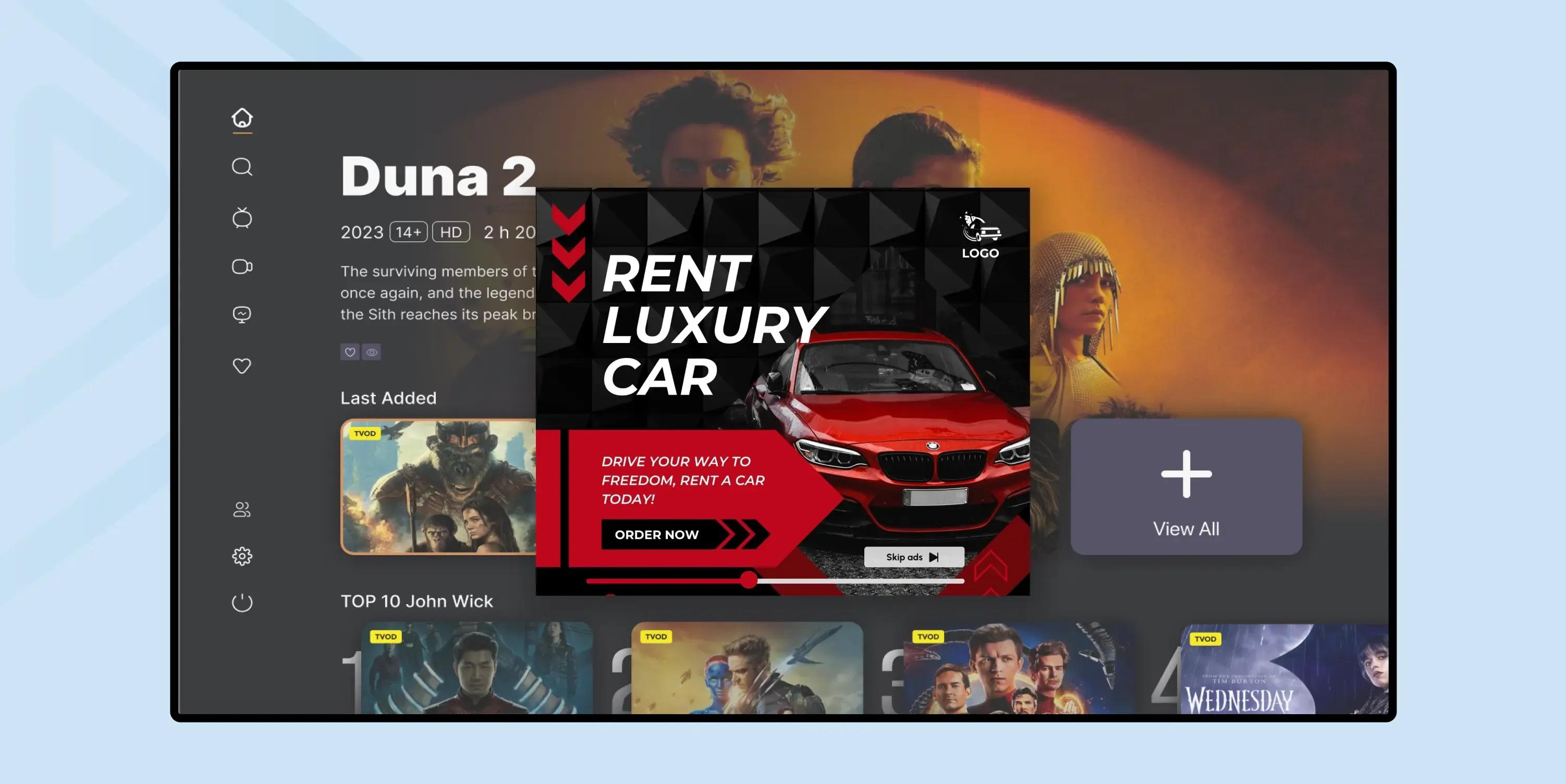
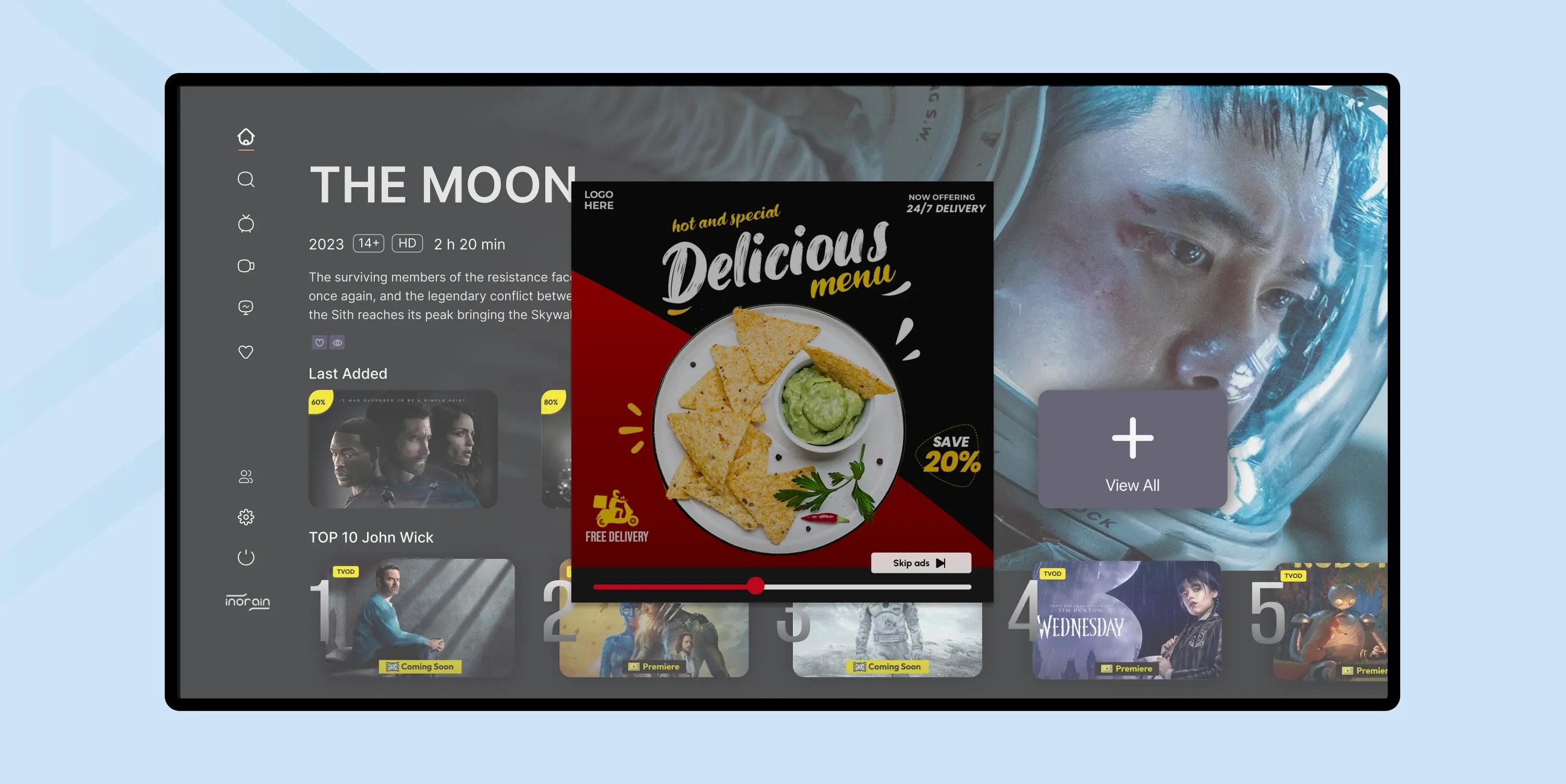
Follow a single impression from end to end. A break opportunity is signalled in the content, either by an SCTE-35 marker in a live stream or by a VMAP (Video Multiple Ad Playlist) document for on-demand. As the player approaches it, an ad request goes out carrying what the platform knows and is permitted to share: device type, content genre, rough geography, consent status. An ad server or SSP (Supply-Side Platform) decisions the break against whatever demand is available. The winning response comes back as VAST (Video Ad Serving Template), an XML document telling the player where the creative lives and which tracking beacons to fire. The ad is then either stitched into the video stream before it reaches the player or fetched separately by the player itself. Once it plays, beacons report back, and those reports are what you invoice against.
Two things follow from that sequence. The break has to be marked before it can be sold, which makes ad markers an encoding and packaging decision rather than a sales one. And the request has to carry enough signal to be worth bidding on, which makes your data handling a pricing decision.
The mechanism that makes all of this possible at scale is dynamic ad insertion, and it is the reason two viewers watching the same episode at the same moment can see entirely different ads.
What is an OTT ad break actually worth?
An ad-supported streaming hour earns about $0.21 when every available slot in it sells, which is a useful benchmark precisely because almost nobody achieves it. Omdia measured ad-supported CTV (Connected TV) services across eight markets through 2025 and found the industry running at just 65% of its own commercial capacity, and at only 32% of the maximum ad load regulators permit on linear broadcast television. Its conclusion was that revenue could rise two to threefold if those hourly volumes were expanded and filled (Omdia, 2026).
Read that as an operator rather than as an analyst. The constraint on OTT advertising revenue is not advertiser demand. It is inventory that was never built and inventory that was built but never sold.
Those are two problems with two different fixes. Unbuilt inventory is an engineering question: breaks that were never marked, formats the platform cannot serve, ad pods with one slot where there could be three. Unsold inventory is a demand question: too few buyers connected, floor prices set wrong, or targeting signals too thin to attract a bid.
Most operators assume they have the second problem. Omdia's capacity figure suggests many have the first. US inventory also carries roughly a 30% price premium over comparable markets, so the same gap costs an American operator more.
Where that revenue sits alongside subscriptions and transactions is covered in our guide to OTT monetization.
Which ad formats can your inventory carry?
Your platform can carry eight commercially meaningful ad formats, and each trades revenue against viewer patience differently. This is what you are choosing between, not what an advertiser is.
| Format | Where it sits | What it earns | What it costs you |
|---|---|---|---|
| Pre-roll | Before playback starts | High completion, reliable demand | Delays time-to-first-frame, the metric viewers judge you on |
| Mid-roll | At marked breaks in content | Highest yield per slot | Needs real break points; badly placed ones drive abandonment |
| Post-roll | After content ends | Low competition, cheap to run | Weak completion; many viewers have already navigated away |
| Pause ads | On the pause screen | Incremental, no interruption cost | Requires player support; limited to sessions with pauses |
| Overlay and L-band | Over playing content | Sells without stopping the video | Intrusive if overused, and unsupported on some TV platforms |
| Interactive | Within a video slot | Premium CPMs, richer measurement | Client-side execution, which complicates ad insertion |
| Sponsored and branded content | Inside or around the catalog | Direct-sold, no auction take-out | Sales effort and editorial involvement per deal |
| Companion and display | In the app interface | Fills inventory outside video | Low value on television screens; better on mobile and web |
Two of these carry enough weight to have earned guides of their own: pre-roll video ads and post-roll ads.
The formats you can offer are set by the player and the packaging, which brings up the single most consequential technical decision on this page.
SSAI or CSAI: how do ads get into the stream?
SSAI (Server-Side Ad Insertion) stitches ads into the video stream before it reaches the player, so the viewer receives one continuous stream. CSAI (Client-Side Ad Insertion) leaves the player to request and play the ads separately from the content.
Three consequences separate them, and none is a matter of preference.
Ad blockers can see a separate ad request and block it. They cannot easily see a stitched stream, because it looks like the content. Playback continuity is the second: a stitched ad uses the same player, buffer and bitrate ladder as the content, so the transition is invisible, while a client-side ad spins up its own playback and often stutters at exactly the moment you have the viewer's attention. Measurement is the third, and it cuts the other way, because server-side insertion pools viewers behind a common request and makes device-level frequency capping harder.
For CTV, SSAI is the working default, and it is what most buyers expect when they ask what your inventory runs on. CSAI holds on where interactivity or genuinely client-specific targeting matters more than continuity.
The full comparison lives in SSAI vs CSAI, with the mechanics in what SSAI is and the CSAI glossary entry.
What do you have to build to accept ad demand?
Six components stand between a streaming platform and a saleable ad break, and missing any one of them makes your inventory unbuyable rather than merely underpriced.
Ad markers. Break opportunities have to exist in the content before they can be sold: SCTE-35 markers inserted at the encoder for live, a VMAP document describing break positions for on-demand. Retrofitting markers across an existing catalog is slow work, which is why this belongs at the packaging stage rather than the sales stage.
An ad server or SSP connection. Something has to decide which ad fills a given slot and record what happened. An ad server handles your directly sold campaigns; an SSP connection exposes the remainder to programmatic buyers. Most operators need both, and the two have to agree on priority.
VAST and VMAP compliance. These are the response formats every buyer assumes. A platform that cannot parse VAST correctly, or that mishandles the wrapper redirects buyers routinely use, will not be bought from. Unglamorous integration work, and not optional.
Ad pods. A pod is multiple slots inside one break, with rules governing separation and competitive exclusion so a viewer does not see two car ads back to back. Pods are also where most unbuilt capacity hides: a two-minute break holding one 30-second ad is three quarters empty.
Identity, consent and privacy signals. What you can pass about a viewer, lawfully and accurately, does more to set your CPM than any other single factor. Operators with a billing relationship hold an advantage here, because a subscriber relationship is first-party by definition. Handled carelessly, it is also the fastest way to lose buyers and regulators alike.
Frequency capping and ad-experience controls. These exist to protect the asset. Repetition is the complaint viewers make about ad-supported streaming, and the operator is the only party positioned to fix it, because only the operator sees every break.
Two of these deserve a closer look on their own terms: addressable TV advertising explains what targeted delivery requires in practice, and the addressable advertising glossary entry covers the terminology. All six sit on top of the delivery pipeline described in our guide to OTT technology.
If you are weighing what this stack looks like against your existing infrastructure, inoRain builds it as a managed layer for network operators. Start with OTT for ISPs or OTT for TV providers.
Where does OTT advertising demand come from?
Advertising demand reaches your breaks through three routes, and almost every platform of any size runs all three at once with a price floor separating them.
Direct-sold means your own salespeople negotiating with advertisers or agencies. It earns the highest CPM and costs the most to operate, needing headcount, a rate card and someone to traffic the campaigns. It works when you have an audience worth asking for by name.
Programmatic covers everything automated, and it is a ladder rather than a single thing. Programmatic guaranteed fixes both price and volume in advance. A private marketplace opens your inventory to invited buyers at a floor you set. The open exchange takes whatever is left at whatever it clears for. Yield falls at each step down, and so does the effort required.
Ad networks and rep firms sell on your behalf for a share of revenue. This is the lowest-effort route and the lowest-yielding one, which makes it a sensible floor under remnant inventory rather than a strategy.
The money moving through these pipes is not in short supply. US digital video ad spend passes $80 billion in 2026, growing 11% and roughly 20% faster than the total advertising market, and digital video crosses 60% of all TV and video ad spend for the first time (IAB, 2026).
For how this lands against a broader streaming context, see streaming advertising.
Which numbers decide whether it works?
Six metrics determine whether your ad inventory earns anything, and they resolve into a single identity worth committing to memory:
Revenue per viewing hour = ad load × fill rate × CPM ÷ 1,000
Everything else on this page is a way of moving one of those three terms.
Ad load is minutes of advertising per hour of content. It is the term you control most directly and the one with the sharpest downside, because every additional minute is revenue you can model and churn you cannot.
Fill rate is the share of available slots that actually sell. A low fill rate means demand is not reaching your inventory, which is a connection and floor-price problem rather than a content problem.
CPM (Cost Per Mille) is revenue per thousand impressions, and the number that matters to you is what you receive after the ad chain takes its share, not the headline rate a buyer pays.
Completion rate is the share of ads played to the end. On CTV this should be high, and a low figure usually points at an insertion or buffering fault rather than viewer behavior.
Ad-supported ARPU (Average Revenue Per User) converts the rest into the number your business plan uses, and it is the only one directly comparable to your subscription tier.
Churn attributable to ad experience is the hardest to measure and the most expensive to ignore. It is why ad load is a business decision rather than an engineering one.
The demand side is large enough that fill rate is worth fighting for: there are now more than 110 million ad-supported streaming plans in the United States alone (Antenna, 2026).
Instrumenting these properly is its own discipline, covered in OTT measurement and OTT analytics.
OTT, CTV or OLV: which inventory are you selling?
You are usually selling more than one of these, and buyers price them differently.
| OTT | CTV | OLV | |
|---|---|---|---|
| Environment | Streaming content on any connected device | Streaming content on a television screen | Video on web and social, in-page or in-feed |
| Typical buyer | Video and performance budgets | Television and brand budgets | Digital and social budgets |
| What it changes for you | Broadest reach, most varied player estate | Highest CPM, strictest measurement expectations | Lower CPM, more formats, weaker completion |
CTV is the premium slice of OTT rather than a separate market, and the distinction is the screen rather than the technology. See OTT vs CTV, OLV vs OTT vs CTV and the CTV glossary entry.
Which monetization model does your ad inventory plug into?
Advertising revenue plugs into three models, and they all run on the same ad stack described above. What differs is entitlement and where the ad load sits, not the technology underneath.
An AVOD (Advertising-based Video On Demand) service is free to the viewer and funded entirely by the break. A FAST (Free Ad-Supported Streaming TV) channel applies the same logic to a linear schedule, and it is the fastest-growing shape of the three: Omdia put global FAST revenue at $6 billion in 2025 and projects $11 billion by 2030. A hybrid service sells subscriptions and advertising together, usually with a cheaper ad-supported tier beneath an ad-free one.
The practical requirement is that your stack supports whichever model you choose, and whichever one you switch to two years from now. Start with what AVOD is, then FAST vs AVOD and hybrid OTT monetization.
What do you actually have to decide?
Four decisions shape an OTT advertising operation more than any others, and three of them are made before you sell a single impression.
SSAI or CSAI. Largely settled for you by your device mix. If CTV is a meaningful share of your viewing, server-side insertion is the answer, and the remaining question is whether you also need a client-side path for interactive formats.
Direct, programmatic, or both. A sales team is a fixed cost that only pays back above a certain audience size. Programmatic is available immediately and gives away margin at every step. Most operators end up with both and a floor price holding the line between them.
Your ad load target. Set it from your content and your subscription position, not from what the market permits. An operator whose ad tier undercuts a subscription tier has a different tolerance than a free channel with nothing to protect.
Build or license the ad stack. Ad server, insertion, identity and reporting are four integrations, not one, and each carries ongoing operational work rather than a one-off build. The honest test is whether ad operations is a business you intend to be in, or a capability you need to have.
How these decisions interact with the rest of your commercial model is covered in OTT business models.
Monetize your OTT inventory with inoRain
inoRain provides white-label OTT infrastructure with the advertising layer built in: ad marker support, server-side insertion, VAST-compliant serving, ad pod management and the reporting to invoice against. Operators launch on it rather than assembling it from four vendors.
If you are a creator or a channel owner rather than a network operator, start with OTT for content creators. Whichever model you run, the first questions worth answering are your device mix, your existing ad relationships, and where your inventory is currently going unsold.
Explore OTT advertising and monetization in depth
Each part of this guide has a dedicated resource. The rest of the cluster:
Ad-supported models - AVOD glossary · HVOD glossary · what BVOD is · BVOD glossary
FAST channels - what a FAST channel is · how to launch a FAST channel · FAST channel distribution · FAST channel services
Revenue beyond advertising - content monetization · live streaming monetization · video monetization platforms · OTT billing · video paywalls · pay-per-view streaming
Reach and promotion - OTT marketing · OTT marketing strategies · OLV advertising
Where does OTT advertising go next?
Two shifts are already underway, and neither is a prediction.
The ad tier became the front door. Advertising-supported plans stopped being the discount option and turned into the default way people start a streaming subscription. Deloitte found that 68% of streaming subscribers now hold at least one ad-supported plan, up from 46% two years earlier (Deloitte, 2026). For a platform, that changes what the ad stack is: not a monetization experiment on the side, but the revenue path most of your new viewers arrive on.
Addressability is being rebuilt under privacy constraints. The identifiers that carried targeting for a decade are going away, and what replaces them is a mix of clean rooms, contextual signals and first-party data. This favors operators. An ISP or a TV provider with a billing relationship holds exactly the kind of consented, first-party understanding of a household that the rest of the market is now paying to approximate.
Conclusion
The gap in OTT advertising is not between platforms that have an audience and platforms that do not. It is between the inventory an operator owns and the inventory it can actually sell, and that gap is closed with ad markers, insertion, clean signals and enough demand connections to fill a pod, rather than with more viewers.
That work compounds. Every break you mark and every slot you can fill raises the yield on an audience you are already paying to serve, and the operators building this now are doing it while the ad-supported majority is still forming rather than after it has settled.
If you want to know what your current inventory could be earning, contact us and we will look at your break structure, your device mix and where the demand is missing.
Frequently Asked Questions

Co-founder / CTO
Armen is the CTO and Co-Founder of inoRain OTT and Co-Founder of HotelSmarters, specializing in advanced streaming technologies, OTT strategy, and interactive TV systems. He builds scalable end-to-end video delivery solutions and drives technical innovation across hospitality and streaming platforms, bridging complex engineering with practical business impact.
Subscribe to Our OTT Blog
Want to learn more about OTT technology and monetization? Leave your best email here, and we'll keep you updated with our weekly articles.
Loading...