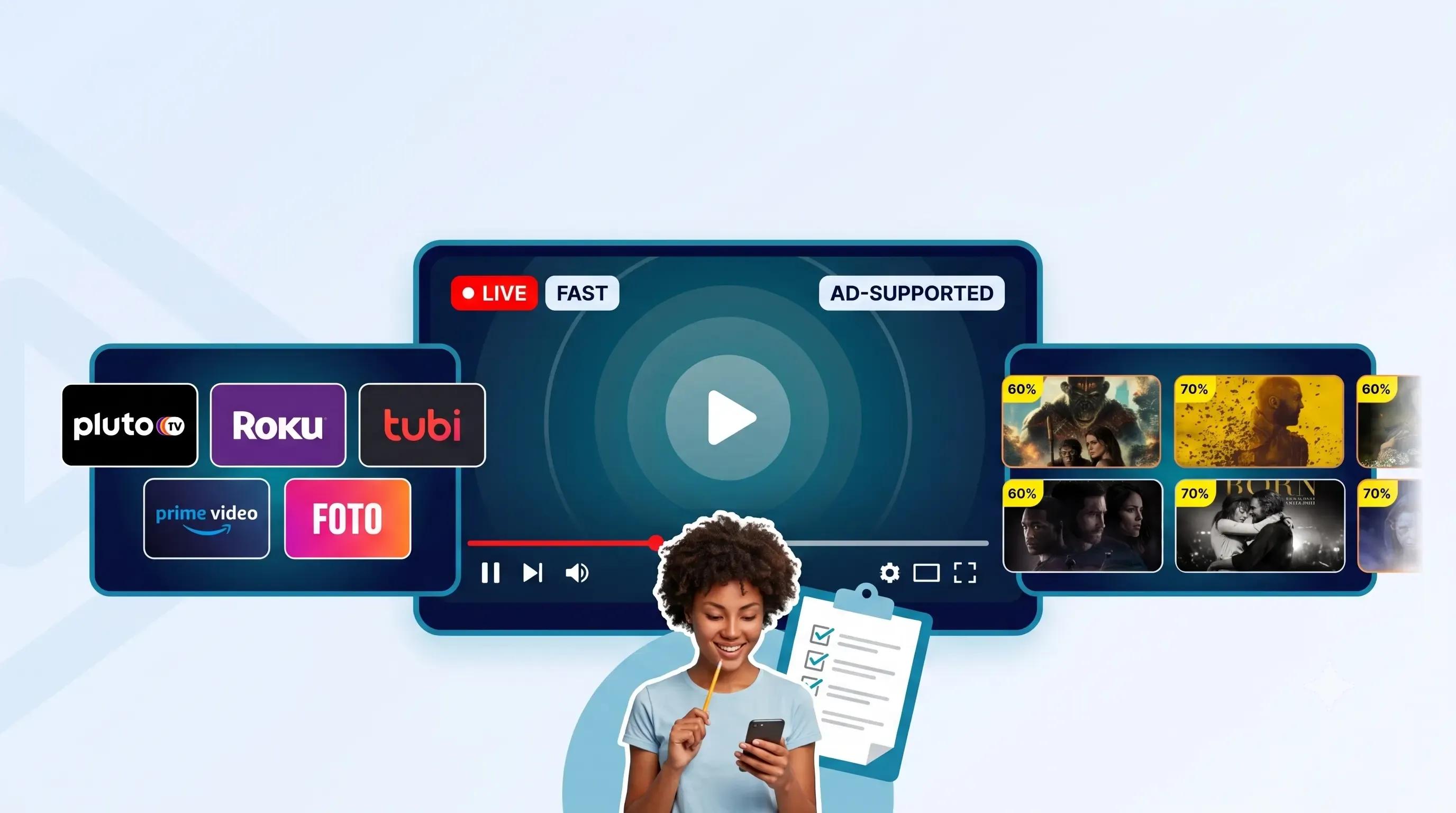
FAST Channel Distribution: How to Get Your Channel Seen

Building a FAST (Free Ad-Supported Streaming TV) channel is the easy part. Getting it in front of viewers - and keeping it there - is where channels win or die. More than 1,500 unique FAST channels were live in the US by late 2025, and the major platforms have become far more selective about which ones they carry. Distribution is no longer an afterthought; it's the strategy.
FAST now accounts for 6.8% of all US TV viewing time (Nielsen Gauge, 2025) and reaches roughly 60% of US households. That audience is real, but it's spread across a handful of powerful platforms, each with its own economics and onboarding bar.
This guide explains what FAST channel distribution actually involves, the two routes you can take, where you can distribute, how the money works, and how to choose the right mix.
If you haven't built your channel yet, start with our step-by-step guide to launching a FAST channel - this article picks up where that one ends.
What is FAST Channel Distribution?
FAST channel distribution is the process of getting a linear, ad-supported channel in front of viewers across connected-TV (CTV) platforms, streaming devices, mobile apps, and the web. It's the reach layer that sits on top of a channel you've already built and scheduled.
It helps to separate distribution from the steps that come before it. Playout and origination turn your library into a continuous, scheduled FAST channel signal. Distribution is what happens next: delivering that signal to the places viewers actually watch. Launching a channel is the full build; distribution is specifically about where it lives and who sees it.
Owned vs. Third-Party Distribution - What's the Difference?
There are two ways to distribute a FAST channel: through your own apps and platforms (owned distribution), or by syndicating to third-party FAST services (aggregators). Most operators use a combination of both.
Owned distribution
Owned distribution means carrying the channel inside apps and platforms you control - your branded CTV app, website, or existing streaming service. You keep more of the ad revenue and, just as importantly, you keep the viewer data. The trade-off is that discovery is on you: you have to drive audiences to your own destination rather than borrowing someone else's.
Third-party / syndicated distribution
Syndicated distribution places your channel on established FAST platforms that already have millions of viewers. The upside is instant reach - you plug into an existing audience instead of building one. The trade-off is a revenue-share split with the platform and less direct access to viewer data.
Neither route is inherently better. Owned distribution protects margin and data; syndication buys reach and speed. The right answer is usually a hybrid: syndicate for scale while building owned distribution to capture higher-value viewers over time.
Where Can You Distribute a FAST Channel?
FAST channels reach viewers through large aggregator platforms and CTV app ecosystems. These are distribution destinations - the "shelves" your channel sits on - and their scale is the reason syndication is so attractive.
The biggest destinations give a sense of the reach available. Samsung TV Plus carries around 700 channels in the US and more than 3,500 internationally, with roughly 88 million monthly active users. The Roku Channel offers over 500 free channels. Pluto TV, Tubi, and LG Channels round out the set of platforms where most US FAST viewing happens.
That reach comes with a catch. With 1,500+ channels competing for placement by late 2025, platforms have grown selective about what they carry. A clear editorial concept, quality programming, and clean metadata now matter more than ever - the low cost of launching gets you in the door, but differentiation is what keeps you on the platform.
How Does FAST Distribution Make Money?
FAST distribution revenue comes from advertising, and that revenue is split between the channel owner and the distribution platform. Four variables decide how much you actually earn: CPM (Cost Per Mille, the price per 1,000 ad impressions), fill rate (the share of ad slots that get sold), ad load (minutes of ads per hour), and the revenue-share split with your distribution partner.
The revenue share is the most commercially sensitive number in the whole model. On platform-sold inventory, industry estimates put the channel owner's take at roughly 35-50% of ad revenue, with the platform keeping the rest in exchange for the audience, the technology, and often the ad-sales relationships. Owned distribution flips that equation - you keep far more of each dollar because there's no platform taking a cut.
This is the core reach-versus-margin trade-off. Syndication maximizes impressions but shrinks your share of each one. Owned distribution maximizes your share but requires you to generate the audience. For monetization mechanics like SSAI (Server-Side Ad Insertion) and running FAST alongside AVOD (Advertising-based Video On Demand), the same infrastructure typically serves both.
Owned vs. Third-Party - How Do You Choose?
Choose your distribution mix based on four things:
- how much revenue you need to retain,
- how much you value first-party viewer data,
- how fast you need to scale,
- how much brand control matters to you.
If margin and data are the priority - say you're building a long-term direct relationship with viewers - weight toward owned distribution and treat syndication as a discovery funnel. If speed and reach matter most, and you're comfortable trading margin for scale, lead with syndication to the big platforms and add owned distribution later.
Brand-driven operators often start syndicated to prove demand, then invest in owned apps once a channel earns an audience. The decision isn't permanent; the smartest operators shift the balance as a channel matures.
International FAST Distribution
FAST distribution is growing fastest outside the US. Omdia forecasts a roughly $1.6 billion revenue opportunity for FAST channels outside the US by 2027, as platforms expand into Europe, Latin America, and Asia-Pacific (Omdia, 2025). For operators with travel-friendly or language-flexible content, international syndication is one of the clearest growth levers available.
Going global adds complexity, though. You'll need to clear distribution rights on a per-territory basis, localize metadata and often the content itself, and manage separate onboarding for each platform in each region. The reach is worth it - but international distribution is a deliberate rights-and-operations project, not a switch you flip.
How inoRain Helps You Distribute FAST Channels
inoRain gives operators and content owners one platform to run and deliver FAST channels inside their own branded OTT app and across every screen that matters - without stitching together separate systems.
- Keep 100% of your revenue. inoRain takes no revenue share, so every dollar your ad inventory earns stays with you - a sharp contrast to the 35-50% cut third-party platforms typically take.
- EPG and linear scheduling. Smart TV ecosystems like Samsung and Roku require accurate EPG metadata for FAST distribution. Manage scheduling, programming, and real-time EPG updates directly inside your OTT CMS.
- Multi-device delivery. Reach smart TVs, mobile apps, desktop, web, and set-top boxes from a single platform, without managing separate infrastructures.
- CDN + P2P delivery. Content Delivery Network distribution with peer-to-peer assistance keeps quality stable and bandwidth costs down as channel count and concurrency grow.
- SSAI and hybrid monetization. Insert non-skippable, targeted ads and run FAST, AVOD, SVOD, and TVOD under one monetization stack.
- Channel and ad analytics. Track channel performance, ad fill rate, viewer sessions, and revenue alongside your existing VOD analytics.
Because it builds on infrastructure you already run, inoRain is designed for operators who want to launch, distribute, and scale FAST channels without a new engineering project. Contact Us to map your distribution strategy.
Common FAST Distribution Mistakes to Avoid
A few missteps undercut otherwise strong channels. The most common is spreading across as many platforms as possible without a differentiated concept - exactly when platforms are getting choosier, that stretches you thin. Weak or inaccurate metadata is another: it hurts placement and discovery on every platform at once.
Under-negotiating the revenue share leaves money on the table over the channel's entire life. And leaning entirely on syndication, with no owned distribution, means all reach and no margin or data. Start focused, get the fundamentals right, then expand deliberately.
Conclusion
FAST channel distribution is a strategic choice, not a final step. The operators who win treat the owned-versus-syndicated question as an ongoing decision - using third-party platforms for reach while building owned distribution to protect margin and data. As platforms grow more selective and international markets open up, distribution strategy is fast becoming the real differentiator between channels that scale and channels that stall.
If you're ready to get your FAST channel in front of more viewers without a new infrastructure project, talk to the inoRain team.
Launch Your FAST Channel with inoRain
Frequently Asked Questions

Digital Marketing Specialist
Creates digital campaigns that drive growth. Handles social media, SEO, and content marketing. and turns data into clear insights and results. Sona also helps create valuable evergreen content to deliver high-quality information to inoRain's audience.
Subscribe to Our OTT Blog
Want to learn more about OTT technology and monetization? Leave your best email here, and we'll keep you updated with our weekly articles.
Loading...